Get Full Government Meeting Transcripts, Videos, & Alerts Forever!
Get email alerts on the Budget topic
No spam. Unsubscribe anytime.
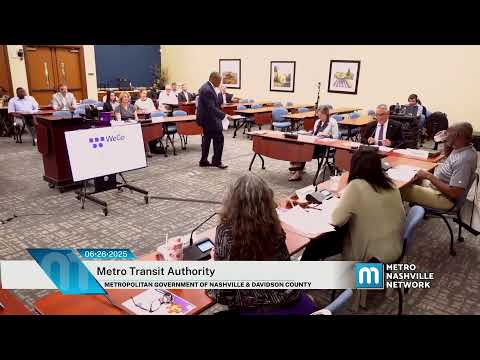
WeGo board approves $30 million operating budget increase tied to 'Choose How You Move' funding
Summary
The Nashville MTA (WeGo) board approved the fiscal year 2026 operating budget that grows roughly 23%, funded largely by the mayor's Choose How You Move sales-tax program. The plan includes a low-income fare program, expanded security spending and reserves; federal pandemic relief funds are exhausted.
The Nashville Metropolitan Transit Authority board on June 25 approved the fiscal year 2026 operating budget, a plan officials said represents a 22.8% increase over the current year — just under $30 million — driven primarily by local funding from Mayor John Cooper's Choose How You Move transportation program.
The budget matters because it channels newly dedicated local revenue into operating needs that had previously relied on federal formula or pandemic-relief funds, funds agency staff said are now depleted. "This operating budget would represent a 23% increase from the current fiscal year or just under $30,000,000," staff said during the meeting.
Steve Bland, staff member, presented the plan and said the budget is the first full year to include revenues generated through the Choose How You Move program. Bland described several major program-level changes: a new low-income fare subsidy intended to provide free transit to Davidson County residents who meet a low-income threshold; a plan to replace two unreimbursed homeless-related ride programs (Connector Card and Severe Weather Cord) with Lyft-funded rides; and a significant operating reserve funded under the mayor's program.
Bland said staff project the low-income fare program will be reflected in passenger-revenue estimates and that the agency is preliminarily projecting roughly $2 million in Lyft-related revenues tied to replacement of the homeless-related programs. He cautioned the Lyft estimate is preliminary and adoption rates are uncertain; staff's surveys suggested up to 75% of current riders could be eligible for the low-income program. Bland also told the board that state operating assistance rose from about $5.4 million to roughly $6.2 million in the draft budget, an increase of about 16%.
On federal funds, Bland told the board that WeGo has fully depleted COVID-era pandemic relief funds and that the Choose How You Move revenues allow the authority to keep federal formula funds on the capital side rather than using them for operating needs. He said reserve-account balances will grow under the plan and that the board will see more detailed program recommendations for the low-income fare program in coming months.
Board members asked for clarifications about specific line items, including how the transit-policing unit expenditures will be recorded (staff said the city will pay MNPD directly but the authority will reflect the expense in its financial statements), fuel projections (staff said reductions reflect a hedging program and moderating prices), and timing for service expansions tied to available buses (staff said initial off-peak improvements begin July 6, with further improvements in January 2026).
The board voted to approve action item MA-25-031, the fiscal year 2026 operating budget. The motion to approve was made by Steve Bland; a second was received and the measure carried by voice vote.
What happens next: staff said they will continue coordination with the mayor's office, social-service agencies and advocates to finalize program parameters for the low-income fare program and expect to present implementation recommendations in late summer with the program to begin rolling out by year end.
Sources: Presentation and budget tabulation to the WeGo board, staff remarks by Steve Bland; board vote approving MA-25-031.