Get Full Government Meeting Transcripts, Videos, & Alerts Forever!
Get email alerts on the Long Term Recovery topic
No spam. Unsubscribe anytime.
Lowndes County updates long-term recovery strategy; official to collect roughly $4.7 million in storm reimbursements
Summary
County staff outlined efforts to organize a Community Organizations Active in Disaster (COAD), coordinate long-term recovery case management, partner with local nonprofits and training by FEMA/GEMA, and dispatch an official to pick up nearly $4.7 million in reimbursement checks for storm response costs.
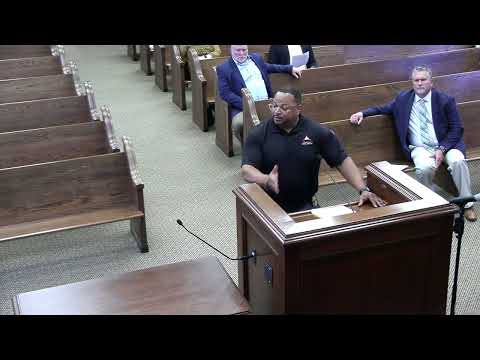
Ashley Tai and county staff updated the Lowndes County Commission on long-term recovery efforts after multiple storms, describing a coordinated local approach that combines Community Organizations Active in Disaster (COAD) work with disaster case management to direct donated and grant resources to residents with remaining unmet needs.
"Long term recovery...the COADs goal is to bring all of the agencies within Lowndes County that have resources together as a group so that when things happen...there's somebody in that group that can fill that need," Ashley Tai said. She credited Frank Richards of Second Harvest Food Bank and United Way for leadership roles in organizing the COAD and long-term recovery group.
Tai said county staff will pick up two reimbursement checks in Atlanta totaling close to $4.7 million for costs paid during Hurricane Idalia and Hurricane Helene. "This is, close to $4,700,000 in what we paid out during the 2 storms that has been approved for reimbursement, and those checks have been cut," Tai said; she said the county will not "trust that the check is in the mail" and will retrieve them in person.
Speakers described disaster case management as a priority to ensure donated and recovery funds reach residents with verified gaps after insurance and FEMA assistance. Tai said the nonprofit Inspiritus is already doing roof repairs and that training by GEMA and FEMA will be held at Second Harvest in July to improve local long-term recovery capacity.
County officials emphasized that long-term recovery is a sustained effort requiring organized local capacity: the commission heard that prior attempts to stand up a long-term recovery structure had uneven attendance and sustainability problems, and staff said the current effort is intentionally deliberate to create a sustainable, locally based system.
No formal vote was required; the update was informational and commissioners thanked staff and local partners for the coordination work.