
Brown Act, Public Records and conflict rules reviewed in Malibu commissioner training
Get AI-powered insights, summaries, and transcripts
Subscribe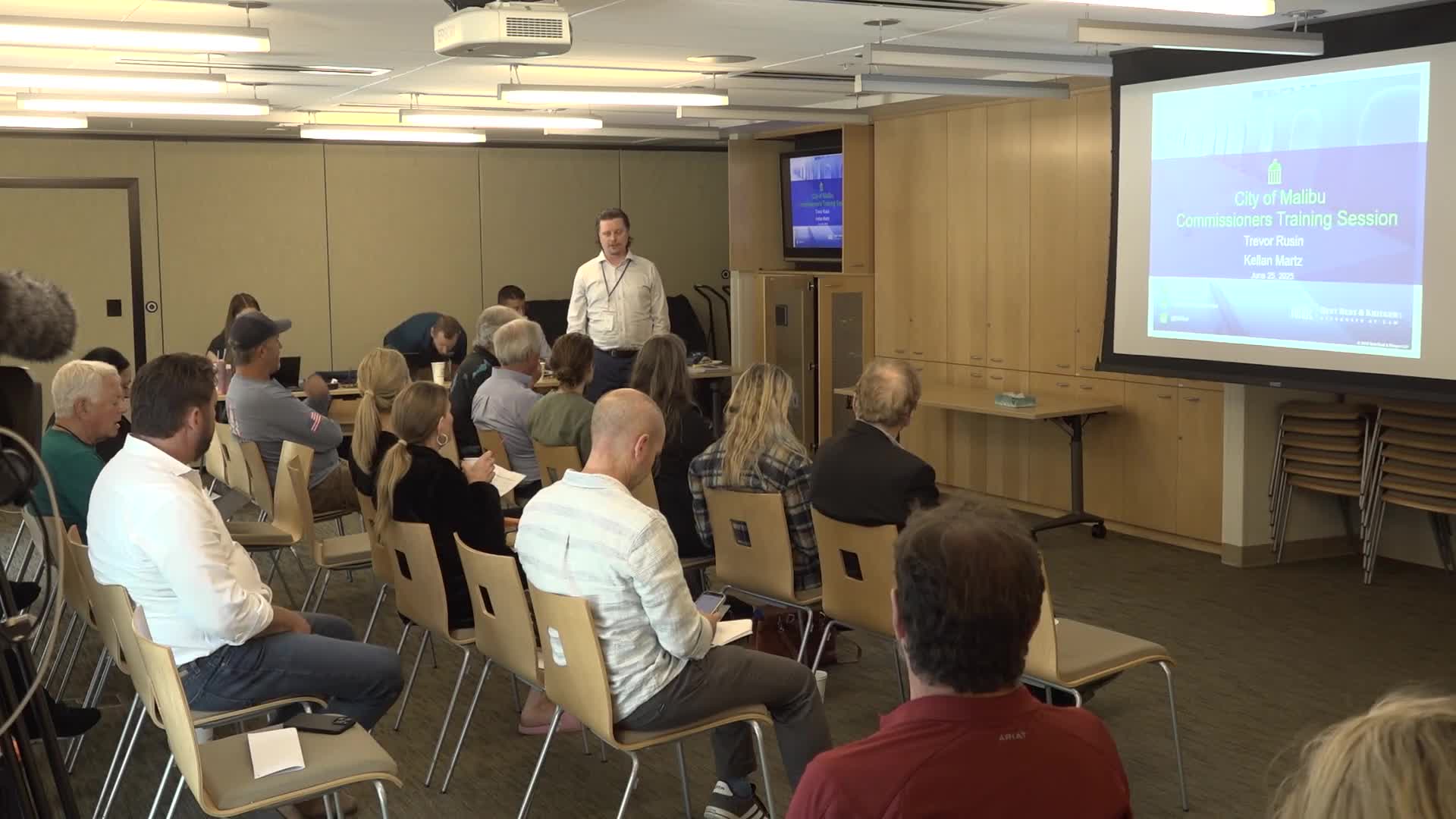
Summary
City attorneys led a session for commissioners and council about Brown Act open‑meeting rules, Public Records Act obligations and conflict‑of‑interest standards under the Political Reform Act, including guidance on personal devices, serial meetings and recusals.
Malibu commissioners and council members attended a legal training session that reviewed California open‑meeting rules, public‑records obligations and conflict‑of‑interest standards that apply to elected and appointed officials.
Assistant City Attorney Kellen Martz and City Attorney Trevor (surname not specified in the public transcript) led the session, which covered practical guidance on the Brown Act, the California Public Records Act and the Political Reform Act, and illustrated common pitfalls — including “serial meetings,” undeclared ex‑parte contacts and using personal email or phones for city business.
“Don’t respond to other people’s posts,” Trevor said in a portion of the training that reviewed online interactions, warning that social‑media replies by multiple commissioners can create the appearance of a deliberative, majority discussion outside a public meeting. The presenters emphasized that typical staff‑to‑commission informational communications are allowable, but commissioners should not conduct deliberations outside noticed public meetings.
The training also addressed records law. Presenters reminded commissioners that communications about city business, even on personal devices, can be subject to public‑records requests. “Records related to the public’s business regardless of their physical form or characteristics sent or received by officials via their personal devices are available for public inspection,” the trainer said, summarizing current case law guidance and advising commissioners to use a dedicated account for commission business if they do not want to mix personal messages with official communications.
On recusals and conflicts, the attorneys explained two common tests: a bright‑line approach (property or financial interest within 500 feet typically creates a required disqualification) and a materiality/context test for interests at farther distances. They also discussed the common‑law bias doctrine: officials must be fair and impartial, and should decline to participate when preexisting statements or relationships would prevent a neutral decision.
The workshop included a question‑and‑answer period on frequently encountered scenarios, such as whether commissioners can visit project sites, whether media or reporters may be asked to gather information, and how to handle off‑record or post‑hearing inquiries. Trainers advised that fact‑gathering site visits are generally acceptable if disclosed in the public record, but warned against coordinated outreach that could look like off‑record deliberation.
The training closed with reminders about gift limits, disclosure thresholds and procedural best practices for quasi‑judicial hearings: call for disclosure of ex‑parte contacts, ask factual questions before the public hearing opens and rely on the administrative record when making findings. Attendees were given guidance to send follow‑up legal questions individually to the city attorney’s office rather than to the commission as a whole.
No formal council action resulted from the training; the session was instructional and intended to reduce legal risk by clarifying statutory and case‑law obligations.