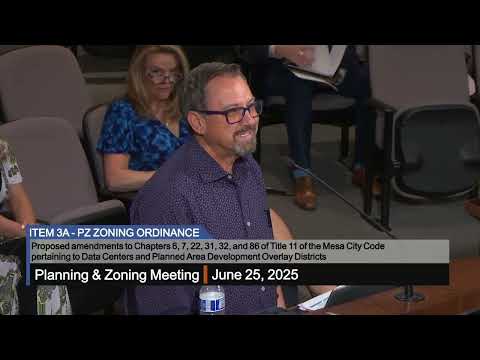
Mesa planning board backs data‑center code changes, 6‑1
Loading...
Summary
On June 25, 2025, the City of Mesa Planning and Zoning Board voted 6‑1 to recommend amendments to the city code regulating data centers, advancing the proposal to City Council for introduction July 1. The measure adds a definition for "data center," sets development standards and setbacks, and establishes a waiver process for some properties.
Mesa — The City of Mesa Planning and Zoning Board voted 6‑1 on June 25, 2025, to recommend that the City Council adopt a package of code amendments regulating data centers, including a new definition for “data center,” development standards, a minimum parking requirement, and restrictions on placement and screening.
The vote followed more than an hour of public comment from industry representatives and residents that centered on economic benefits, land‑use clarity and neighborhood impacts. Chair Ayers moved to approve the board’s recommendation and the motion passed with a 6‑1 vote; the item was scheduled for City Council introduction on July 1, 2025.
Why it matters: Mesa has seen a rapid increase in data‑center activity and the proposal is an attempt to balance economic development with protections for nearby residential areas. Supporters said clearer rules will help the city retain and attract large investment; opponents and some developers asked for more time to refine waiver language, setbacks, screening and how the rules apply to previously approved sites.
Industry speakers emphasized the economic scale of the sector. Russell Smolden, a representative of the Data Center Coalition, said Arizona’s data‑center industry supports thousands of jobs and large local investment, calling it “a big group of players.” Mark Bauer of JLL and other site‑selection consultants told the board that uncertainty can push investment to other markets and urged the city to clearly signal where data centers are welcome.
Several firms with projects already approved in Mesa raised specific legal and implementation questions. Ben Graff of Quarles & Brady, representing Nova Holdings LLC, urged more time to resolve ambiguity in the waiver language and how the ordinance treats site‑plan amendments and Planned Area Development (PAD) deviations. Graff said, “we do, in fact, need more time to review this before it goes to council.”
Residents and neighborhood representatives asked the board to protect neighborhood character and aesthetics. Anthony Grunovich, a resident of Eastmark, said people in his neighborhood feel “trapped” when large data‑center walls rise close to homes and asked the board to require design reviews and stronger screening to help attract compatible retail and other uses.
City planning staff, represented in the hearing by Rachel (last name not provided), answered technical questions and described how the draft ordinance addresses several common concerns. Staff clarified that the proposed 400‑foot separation is measured to the property line of the closest residentially zoned property and that accessory uses, setbacks and MEP (mechanical, electrical and plumbing) screening are part of the proposed development standards. Staff added that “The waiver only applies to the use” (not to automatically freeze prior development standards), and that waivers granted would attach to the property and travel with it when sold.
Board discussion reflected the balance the city is trying to strike. Some members said the rules give residents protections while still allowing Mesa to benefit from tech investment; others said additional clarification would help reduce uncertainty for developers. Several board members and speakers flagged specific items for additional attention: the 400‑foot separation metric, whether PAD standards should be subject to deviations, whether a 10% accessory‑use cap is appropriate for advanced manufacturing campuses that may include significant computing, and the timing for acoustic studies.
Action and next step: The board’s action (Item PZ25057) was a recommendation in favor of the ordinance amendments to Chapters 6, 7, 22, 31, 32 and 86 of Title 11 of the Mesa City Code pertaining to data centers and Planned Area Development overlays. Chair Ayers made the motion to approve the staff recommendation; the motion was seconded and passed 6‑1. The board’s recommendation moves the amendments to City Council for introduction on July 1, 2025.
What remains unresolved: Developers asked for clearer language about whether previously approved sites or minor site‑plan amendments would lose eligibility for a waiver; several industry representatives asked staff and council to consider allowing PAD deviations in limited circumstances. Residents asked for firm design standards to prevent large, unshielded walls and continuous lighting facing backyards.
The board adjourned after the vote and staff noted the item will be introduced to City Council on July 1.