Citizen Portal

Armenian, regional experts tell U.S. Helsinki Commission a signed Armenia–Azerbaijan peace treaty could unlock trade and security but faces political hurdles

Get AI-powered insights, summaries, and transcripts

Subscribe
AI-Generated Content: All content on this page was generated by AI to highlight key points from the meeting. For complete details and context, we recommend watching the full video. so we can fix them.

Summary

Members of the U.S. Helsinki Commission heard a panel of Armenian and regional experts who said a signed Armenia–Azerbaijan peace treaty would institutionalize peace, open transit and trade through the South Caucasus, and present the United States a diplomatic opportunity — but panelists warned political obstacles and the need for concrete implementation mechanisms.

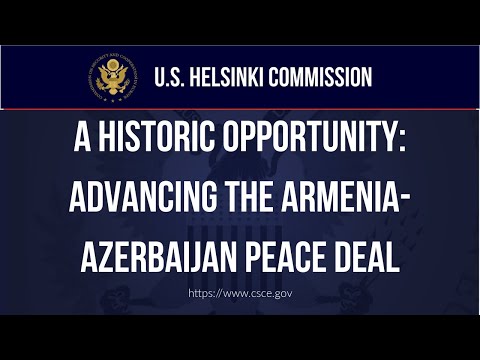
Members of the U.S. Helsinki Commission heard a panel of Armenian and regional experts on the prospects for a signed peace treaty between Armenia and Azerbaijan and the role the United States could play in finalizing and then implementing that accord.

In opening remarks, a member of the Armenia–U.S. parliamentary friendship group in the Parliament of the Republic of Armenia, Ms. Karabatyan, said the two countries had “concluded negotiations on the agreement on peace and establishment of interstate relations,” and that “Armenia has also expressed readiness to sign the peace agreement immediately.” She told commissioners that, in her view, a signed treaty is necessary to “institutionalize peace in our region.”

Why this matters: panelists said a signed treaty would replace ad hoc conflict-management mechanisms, open the South Caucasus to transit and trade, and allow both countries to pursue economic integration and connectivity projects. The panel described the moment as a strategic opportunity for U.S. diplomacy to encourage stability in a region that links Europe and Central Asia.

Panel testimony and major themes

Dr. Jennifer Wistrand, identified in the hearing as deputy director of the Kennan Institute until recently, addressed common narratives about the conflict and cautioned against reducing it to religious terms. “I do not think that this has ever or is now about Christians versus Muslims,” she said, urging that historical and socioeconomic factors be recognized when crafting post‑agreement confidence‑building measures.

A visiting scholar (former member of the Turkish parliament) who spoke to the commission described the South Caucasus as “a crossroads of peace for trade in goods and energy” and emphasized Turkey’s potential role in normalizing relations, saying that opening the land border between Armenia and Turkey would be “a lifeline for Armenia” and could make it easier for Azerbaijan to sign the accord.

Another panelist, identified in the record as a scholar focused on U.S.–Armenia strategic relations, urged stronger U.S. engagement if Azerbaijan continued to delay signature. He recommended a package of measures the United States could consider, including enhanced bilateral security cooperation, targeted economic investment in Armenia, and the option of “trigger” sanctions targeted at Azerbaijani political and military elites if Baku took steps that undermined a negotiated settlement. That speaker framed such measures as tools to change incentives rather than immediate punitive steps.

Obstacles and points of contention

Panelists described several outstanding political obstacles. Azerbaijan, according to testimony, wants Armenia to amend constitutional language that references historical claims and wants the OSCE Minsk Group mechanisms formally dissolved; Azerbaijan’s interlocutors seek these conditions before signing. Armenian speakers warned that conditioning signature on those steps risked perpetuating the status quo and argued that the treaty itself should provide the framework to address those issues.

Speakers also raised concern about power asymmetries on the ground and about the role of external powers. Multiple witnesses argued that Russia has long benefited from frozen conflicts and that a comprehensive, implemented peace would reduce Moscow’s levers in the region. At the same time panelists said Turkey and other regional actors can facilitate or delay implementation: Turkey’s willingness to open its border with Armenia and to press President Ilham Aliyev of Azerbaijan were cited as possible tipping points.

Humanitarian, legal and reconciliation issues

The panel discussed how a treaty could address humanitarian and justice-related claims. Witnesses emphasized that a state-level peace treaty creates the legal and practical scaffolding to address displacement, prisoner releases and the protection of cultural sites, but they also acknowledged that transitional justice and accountability processes would remain challenging. A participant from the audience asked how “peace without justice” could be acceptable given allegations of ethnic cleansing and other wartime abuses; panelists replied that many of the immediate security and humanitarian problems could only be addressed through a binding interstate agreement, after which justice and reconciliation mechanisms would be pursued through separate processes.

Questions from commissioners and the audience focused on sequencing: whether Armenia and Turkey or Armenia and Azerbaijan would normalize relations first; what a “day after” signing would look like; and how the United States could make the costs and benefits of agreement clear to both capitals.

Quotes from the record

“Armenia and Azerbaijan are at a defining moment in their modern history,” Ms. Karabatyan said, urging that a signed treaty “serve as the basis for starting a new relationship between Armenia and Azerbaijan and for the South Caucasus as a whole.”

“I do not think that this has ever or is now about Christians versus Muslims,” Dr. Jennifer Wistrand said when asked whether religious identity was the primary driver of the conflict.

What happens next

Panelists urged sustained U.S. diplomatic engagement to reinforce incentives for signature and implementation. Recommendations ranged from intensified U.S. mediation and engagement with Ankara to economic packages and narrowly targeted measures to deter attempts to block or renege on an agreement. The speakers stressed that even after signature, implementation — delimitation and demarcation of borders, phased reopening of communications and transport links, mechanisms for returns and cultural‑heritage protections — would require sustained, multilateral effort over months and years.

No formal votes, resolutions or committee actions were recorded during this briefing.

Ending note

Witnesses characterized the moment as an uncommon diplomatic opportunity: a signed treaty could reduce long‑running tensions, enable regional connectivity projects and expand U.S. influence in the South Caucasus, but its success depends on sequencing, verification mechanisms and continued engagement by both regional and international partners.