Get Full Government Meeting Transcripts, Videos, & Alerts Forever!
Get email alerts on the Cannabis Regulation topic
No spam. Unsubscribe anytime.
Dakota County board adopts retail cannabis registration ordinance, delegates emergency suspensions to staff
Summary
The Dakota County Board of Commissioners adopted an ordinance to administer retail cannabis registrations and amended the 2025 fee schedule, applying county administration only in cities and townships that consent. The board also delegated emergency license-suspension authority to the county Director of Public Services and Revenue.
The Dakota County Board of Commissioners voted May 20 to adopt an ordinance that lets Dakota County administer retail cannabis registrations and amends the county's 2025 fee schedule to include cannabis licensing fees.
Teresa Mitchell, deputy director of the county's Public Services and Revenue Division, told the board the ordinance "applies only to retail cannabis businesses and lower potency hemp businesses within Dakota County only where the city or township has consented to Dakota County doing that administration." She said the county had received consent resolutions from three townships: Eureka, Hampton and Ravenna.
The ordinance ties the county cap on retail registrations to state statute. "Statute requires 1 per 12,500 residents, which the first countywide cap will be looked at when we receive an application," Mitchell said, adding that the county will not issue a retail registration beyond that population-based limit. She also noted a separate statewide cap to which the Office of Cannabis Management must adhere.
Mitchell listed several changes made after public comment, including striking holiday closures from the county rules because state cannabis law does not align with off-sale liquor statutes and adding a delegation so the county can "suspend a license swiftly." She said the Director of Public Services and Revenue will be delegated authority to enact emergency suspensions and that the Office of Cannabis Management (OCM) will be notified immediately when the county takes enforcement action.
Commissioner Holberg asked about timing and how long the county would wait to see if municipalities meet population thresholds before issuing county-administered licenses. "What's the timing? How long do we get to wait to see if other entities reach the threshold of 35?" Holberg asked. Mitchell replied that the ordinance contains response timelines for applications and that the county must act on applications within the ordinance deadlines and in coordination with OCM.
Commissioner Hoberg praised staff work on the ordinance and asked about mechanisms to evaluate whether local policies are working and to share findings with the state. "How are we going to analyze the policies that we've put in place, make sure they work, and also make sure that we have a feedback loop to the state of Minnesota?" Hoberg asked. Mitchell said the county will coordinate with cities and OCM and can provide follow-up information.
Board members discussed practical differences between city-by-city ordinances and consenting to county administration. Mitchell said one advantage of county administration is a single, comprehensive way to limit the number of retail businesses in rural parts of Dakota County where zoning and building-code-compliant sites are limited.
The board also approved an amendment to the county fee schedule (noted in the presentation as an amendment to the $20.25 fee schedule) so the county can accept and process cannabis applications. Mitchell told the board that OCM is expected to hold lotteries in June to issue retail permits for the townships that have consented to county administration.
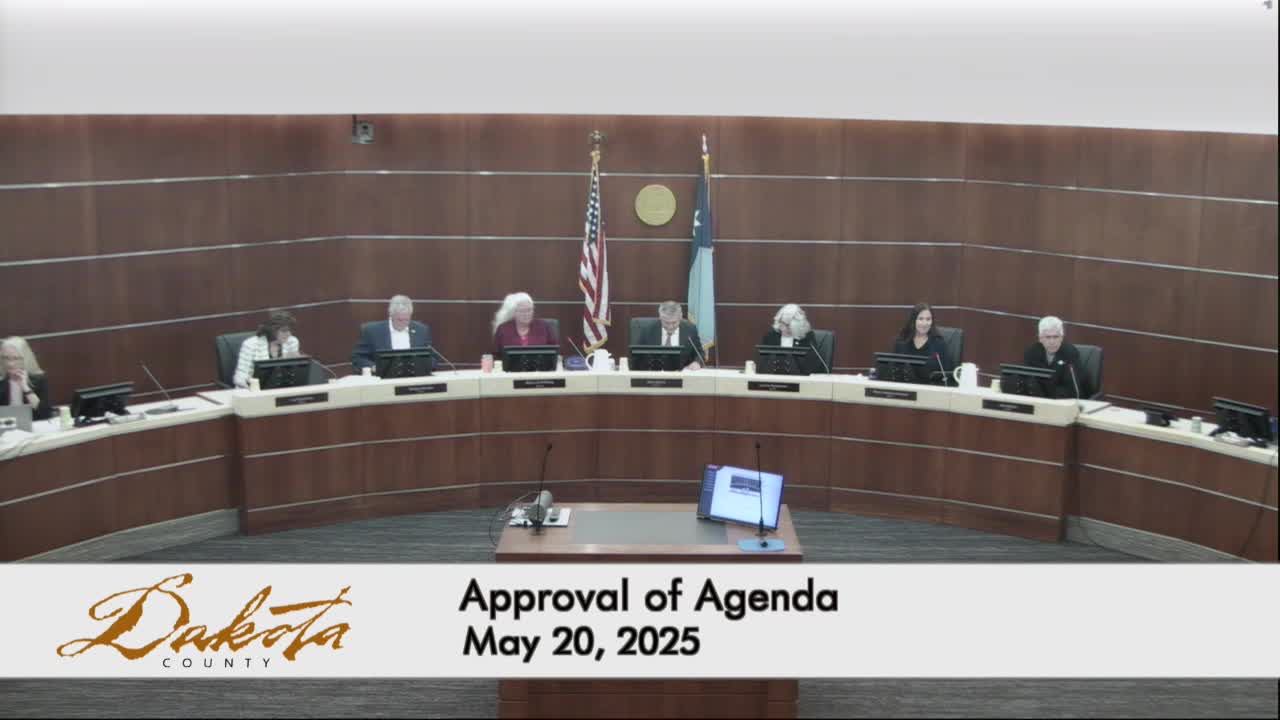
After public comment closed, the board voted on a resolution to adopt the ordinance and amend the fee schedule. The clerk called the roll and the motion carried.
Next steps outlined by staff include posting the adopted ordinance and application materials to the county website and coordinating with consenting cities and townships and OCM on licensing and enforcement procedures.