Get Full Government Meeting Transcripts, Videos, & Alerts Forever!
Get email alerts on the Behavioral Health Code Set topic
No spam. Unsubscribe anytime.
OCA refines behavioral health claims code set; clinicians press to include traumatic brain injury, members debate crisis‑care grouping
Summary
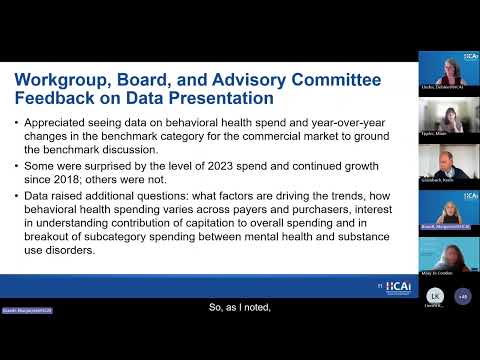
The Office of California presented a revised claims code set to measure behavioral health spending and asked the work group for feedback on whether to include traumatic brain injury and how to categorize crisis and mobile services.
The Office of California (OCA) presented a revised claims code set to measure behavioral health spending and asked its investment and payment work group for feedback on two contested issues: whether to include traumatic brain injury (TBI) diagnoses and whether to replace a community‑based mobile clinic category with a broader crisis care category.
Debbie Lindes, manager of the Healthcare Delivery System Group at the Office of Healthcare Affordability, reviewed the code‑set approach and explained the measurement will span three modules: claims‑paid behavioral health care, non‑claims spending, and a behavioral‑health‑in‑primary‑care module. Lindes said the primary care module exists so integrated primary care behavioral health services can be counted in both primary care and behavioral health without double counting.
Key proposed rules and clarifications
Lindes said OCA will: keep drugs on the code set if at least one approved indication is for a behavioral health condition (while acknowledging some over‑counting of drug spending will occur), and exclude pharmacy spending from the behavioral health benchmark. The code set relies on primary diagnosis plus combinations of service, place‑of‑service and revenue codes to define subcategories. OCA will expand the primary‑care provider taxonomy used for module assignment so services provided by behavioral health clinicians in integrated primary care settings can be captured in both modules.
Two issues drew extended discussion
Traumatic brain injury (TBI): OCA staff noted TBI is not included in Milbank or other states’ behavioral health code sets and warned inclusion would capture non‑behavioral spending (for example, neuroimaging and acute neurosurgical care). Clinicians in the group argued that much of TBI treatment today is behavioral and that excluding TBI would omit neurobehavioral sequelae managed by mental health clinicians. Karnika Saxena, a geriatric psychiatrist representing the California State Association of Psychiatrists, said TBI sequelae are often managed with behavioral interventions and supported including TBI in the code set so those services are not missed. Others cautioned the diagnosis could pull in high‑cost nonbehavioral services if measured only by diagnosis.
Crisis care vs. mobile clinic categorization: OCA proposed replacing a Community‑Based Mobile Clinic Services subcategory with a broader Crisis Care subcategory to reflect state and federal priorities on crisis systems. Lindes cited Substance Abuse and Mental Health Services Administration (SAMHSA) guidance on coordinated crisis care and a March 2025 Department of Managed Health Care all‑plan letter reminding plans of coverage obligations under AB 988 (2022). Several participants, including Vicky and Hector, urged OCA to preserve the ability to distinguish mobile, community‑based crisis teams from facility‑based emergency department crisis care so analysts can compare cost and effectiveness by delivery model. OCA staff said many crisis codes are used for telephone/988 or mobile settings while ED claims often use diagnosis codes rather than crisis service codes, and they will investigate how claims usage patterns map to settings.
Other clarifications
Lindes said inclusion of diagnoses such as autism spectrum and dementia will be refined to include relevant subtypes (including Alzheimer’s disease). OCA will review provider taxonomy expansions to identify provider types that commonly deliver integrated behavioral health in primary care. The staff also noted they will consult clinical experts on specific codes flagged by members and that some codes not uniformly covered by payers are being retained to encourage coverage and ensure comprehensive measurement.
Next steps
OCA will take the work group’s feedback back to staff, continue consultation with clinical experts and HPD analysts, and return in July with more detailed definitions and a finalized code set. OCA plans to begin collecting behavioral health spending reports from payers in fall 2026 and to continue complementary HPD analyses for more granular questions about models of care and where services occur.
No formal vote or board action occurred at this meeting; discussion produced staff commitments to refine definitions, examine how crisis and mobile services appear in claims, and assess whether and how TBI should be included without materially overcounting nonbehavioral medical care.