Get Full Government Meeting Transcripts, Videos, & Alerts Forever!
Get email alerts on the Behavioral Health Benchmark topic
No spam. Unsubscribe anytime.
OCA to delay setting behavioral health investment benchmark to gather more payer data, board suggests revisiting in 2026
Summary
The Office of California (OCA) told its investment and payment work group that it will delay setting a statewide behavioral health investment benchmark and instead collect additional payer data and perform further analyses before proposing a formal benchmark.
The Office of California (OCA) told its investment and payment work group that it will delay setting a statewide behavioral health investment benchmark and instead collect additional payer data and perform further analyses before proposing a formal benchmark.
OCA Assistant Deputy Director Margaret Abbrandt said the agency revised its approach after work group input and recent board and advisory committee discussion, explaining the new plan is to collect payer submissions for performance years 2024–2026 and use that analysis to inform any benchmark set in spring 2028 for performance year 2029. Abbrandt said the delay would allow staff to “identify and resolve challenges with the data submission process” before setting a multiyear target.
Why this matters: A formal benchmark would have directed payers to increase in‑network outpatient and community‑based behavioral health spending by a set percentage each year. Advocates and clinicians said a benchmark could accelerate access to outpatient care and integration with primary care; payers and some board members urged caution without more detailed data on payer variation, capitated payments and county specialty mental health spending.
What the data shows so far
OCA summarized analyses from three sources—Health Care Payments Database (HPD), Covered California and CalPERS—showing commercial payer behavioral health spending rising from about 5% to about 8% of total claims between 2021 and 2023, depending on the source. OCA staff reported that outpatient, community‑based spending has grown faster than other subcategories and that outpatient professional non‑primary‑care services represented roughly 43% of commercial payers’ behavioral health spending in 2023. The share for residential facility services rose from about 4% in 2018 to about 9% in 2023, OCA said.
Board and advisory committee feedback
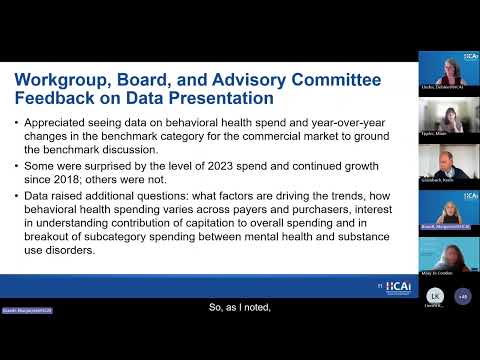
Board members broadly supported delaying a benchmark until more data were available, but some said waiting until 2028 would be too long. The board recommended that OCA and HPD conduct additional HPD analysis and consider revisiting whether a benchmark can be set in 2026; if the evidence remains insufficient in 2026, the board asked OCA to reassess again in 2027. The board also urged OCA to incorporate county‑based specialty mental health services in its measurement as soon as feasible and requested a summary of current programs and funding that could influence spending trends.
Advisory committee members generally endorsed a measurement‑first approach and suggested the benchmark explicitly promote integration of behavioral health into primary care. They also recommended separating mental health and substance use disorder spending for some analyses and asked for greater clarity on how capitated payments and non‑claim spending would be accounted for.
Participant views
Karnika Saxena, a geriatric psychiatrist representing the California State Association of Psychiatrists, told the group she expected spending to continue rising and urged OCA and the board to consider workforce constraints: “I would not be surprised if the spending continues to increase,” she said, adding that provider burnout and shortages affect the state’s ability to scale services.
Kirsten Barlow of the California Hospital Association asked for clarification about next steps and whether the board had taken formal action; OCA staff said the recommendation to delay was a staff proposal that the board and advisory committee discussed but did not formally adopt at the meeting and that OCA will return in July with a formal plan for next steps.
Data scope and next steps
OCA indicated HPD contains data beyond commercial claims—HPD includes commercial, Medicare Advantage and Medi‑Cal submissions, and HPD staff noted county specialty mental health data from county mental health plans are present in HPD but have not yet been analyzed. OCA said it will coordinate with HPD and the Department of Health Care Access and Information (HCAI) and with the Department of Health Care Services (DHCS) to assess how to include Medi‑Cal specialty mental health and other non‑claim spending in measurement.
OCA staff signaled they are leaning toward pausing a benchmark decision for at least a year, performing additional HPD analyses, working with payers and state partners on data submissions, and returning to the work group with a formal next‑steps proposal in July. The timeline presented shows OCA aiming to finalize definitions and code sets this year and to begin collecting behavioral health spending reports from payers in fall 2026.
Discussion vs. action
The work group’s discussion produced no formal board motion or vote. The substantive outputs from the meeting are OCA’s recommended pause to collect further data, the board’s request to evaluate the option of revisiting a benchmark in 2026, and the advisory committee’s endorsement of a measurement‑first approach. OCA will proceed to: (1) collect payer submissions for 2024–2026, (2) run additional HPD analyses including Medi‑Cal and county specialty mental health where feasible, and (3) return with a detailed proposal and timeline to the work group in July.
What remains unresolved
Work group members and committee participants flagged open questions: how to measure capitated payments without double counting, how to capture behavioral health delivered in primary care when the primary diagnosis on a claim is not behavioral health, and how to incorporate county specialty mental health and non‑claim spending into a single measurement framework. OCA said it will use the next year to address these technical issues rather than adopt a benchmark this year.
Looking ahead
OCA plans to post proposed definitions and code sets for public comment after further internal work and to return to the board and advisory committee as the HPD analyses and payer data submissions progress. The work group will reconvene in July to review a formal set of next steps.