Get Full Government Meeting Transcripts, Videos, & Alerts Forever!
Get email alerts on the Mobile Integrated Health topic
No spam. Unsubscribe anytime.
Shelton council hears plan to expand mobile integrated health using opioid settlement funds
Summary
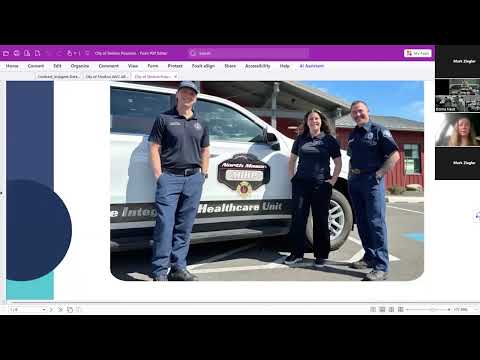
Shelton City Council on Thursday heard a presentation from the Mesa Regional Fire Authority on expanding a mobile integrated health program and a proposal to use opioid settlement funds to seed staff and services.
Shelton City Council on Thursday heard a presentation from the Mesa Regional Fire Authority on expanding a mobile integrated health program and a proposal to use opioid settlement funds to seed staff and services. Abe Gardner, an emergency protection specialist with Mesa Regional Fire Authority, said roughly $107,000 in settlement funds is currently available and described a team model that pairs a physician assistant, peer support specialists and resource navigators with fire and emergency responders.
Gardner said the initiative, which he described as a field-based approach to mental-health and substance-use crises, “was called connections and care.” He told the council the team can provide on-scene assessment, prescriptions and referrals to follow-up care: “We can do prescriptions. We can do,” Gardner said, describing clinical capabilities added to field response.
Nut graf: Council members and local residents framed the proposal as an alternative-response model intended to reduce emergency-room transports and connect people to ongoing behavioral-health care. Presenters said the model is already in use elsewhere in Mason County and argued it can be deployed in Shelton with a combination of opioid settlement funds and other grant dollars, but council members pressed staff about long-term sustainability.
Program model and staffing
Gardner outlined a team built around an advanced practice clinician working with peers and specialists. He described hiring a physician assistant, identified in the presentation as “Adam,” and a behavioral clinician identified as Chrissy (Chrissy/Chrisie Adams in the transcript). Gardner said the team’s purpose is not routine primary care but to stabilize acute situations — mental-health crises, overdose risk or other urgent behavioral-health needs — then link people to services. He said schools, law enforcement and community partners can make referrals and that the program already responds to many nonemergency 911 calls.
Funding and timeline
Presenters said about $107,000 in opioid settlement funds is available to support expansion and that a two-year runway might be possible if other grant money (referred to in the discussion as AWC or similar partner funding) is secured. Council members and other speakers repeatedly asked how the city would sustain the program after seed funding runs out; presenters and staff said the first two years would collect usage and cost-savings data to help solicit partner contributions and insurer or hospital buy-in. The presentation also referenced an interlocal agreement (ILA) as the likely contracting vehicle for shared services across jurisdictions.
Council response and next steps
Multiple council members praised the model. A resident and Rotary Club member who addressed the council said the approach “is something that I would 100% support,” arguing it is more cost effective than repeated emergency-room visits. Council members asked for more detail on who would employ or supervise the coordinator position and whether the city should create a staff position or contract with an outside provider. One council member said they would prefer a contracting arrangement rather than creating a permanent in-house position; another asked how the position would be administered if it were city staff.
City staff and presenters agreed to return with additional details about possible contracting structures, the scope of a proposed systems-coordinator role, the number of positions the grant would pay for, and clearer sustainability plans. Council members agreed to “move the discussion forward” and explore next steps, including where an ILA might fit and which partner agencies could share costs.
Ending: The study-session portion of the meeting concluded with the council directing staff to develop more detail and options for bringing the program to Shelton, including funding scenarios and potential interlocal agreements.