Get Full Government Meeting Transcripts, Videos, & Alerts Forever!
Get email alerts on the Infrastructure topic
No spam. Unsubscribe anytime.
Seaford moves forward on $47M wastewater upgrade; council approves SRF loan authorization
Summary
City presentation laid out a three‑phase plan to upgrade and expand Seaford's wastewater plant to 3 MGD using membrane bioreactor technology; council unanimously authorized acceptance of a Delaware SRF loan to fund the project.
City engineers and consultant GMB presented a multiyear, three‑phase plan June 24 to upgrade and expand the Seaford wastewater treatment plant to a 3 million gallons per day (MGD) capacity and to replace aging equipment. Council then unanimously authorized the city to accept a long‑term loan from the Delaware Water Pollution Control Revolving Fund to finance the work.
Chris Derbyshire, project engineer with GMB, said the recommended treatment approach is a membrane bioreactor system and emphasized that "the membrane bioreactor alternative was the recommended alternative" after reviewing five alternatives. He said the plant had been effectively derated from its original 2 MGD design to about 1.3 MGD after the state's watershed implementation planning process and that ongoing negotiated nutrient allocations allowed the plant to continue operating near 1.4 MGD while the city planned capacity increases.
Derbyshire described the project as three phases. Phase 1 (the "headworks" project) includes a new mechanical screen, modern grit removal, rehabilitation of the lift station and primary clarifiers, and a dedicated automated septage acceptance facility. GMB estimated the total project cost at about $47,000,000; the phase 1 cost was given as $14,340,000. Derbyshire said the phase 1 budget includes design for later phases and that the membrane replacement life was conservatively estimated in the PER at about 10 years (the firm noted 12–15 years can be attainable but used 10 for planning).
On funding, staff described a proposed SRF financing package of approximately $44.66 million. Of that SRF package, Sussex County would cover 40 percent (about $17.86 million) and the City of Seaford would cover roughly 60 percent (about $26.79 million) across all phases. Derbyshire said the city had secured a $2.5 million federal earmark for phase 1 and that SRF financing would be locked at a 2 percent interest rate with a 30‑year term. The city manager and finance director explained phase 1 SRF borrowing would leave the city with an estimated annual payment profile included in the city's FY26 budget planning; the presentation noted a proposed SRF amount for phase 1 in the neighborhood of $11.77 million with an illustrative annual payment amount used for modeling.
Derbyshire also emphasized climate‑resilience considerations: the project design uses a 40‑year sea‑level rise planning horizon and the 100‑year storm or surge elevation for critical structures; he said phase 1 elevations are set higher than the 2‑foot storm‑surge above the 40‑year projection. He added the timeline for all three phases stretches multiple years, and GMB's schedule shows full project completion near fiscal year 2031 absent overlapping contracts.
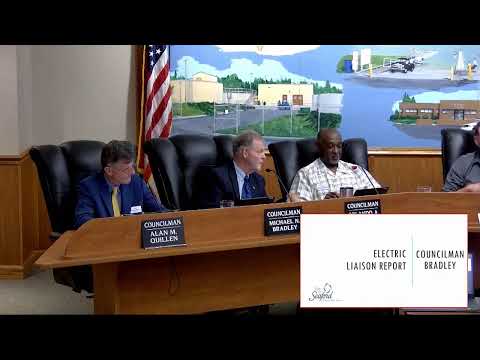
After the technical presentation, Councilman Alan Quillen moved — and Councilman Mike Bradley seconded — a resolution (R2025‑03) authorizing the city to accept the SRF loan for the wastewater upgrade. The roll call vote was unanimous.
City and county staff will continue design and permitting work; staff noted final costs, federal principal forgiveness opportunities for phases 2–3, and coordination with county partners are outstanding items. Council members asked about life‑cycle costs and maintenance: Derbyshire confirmed membrane replacement planning was included in the project's life‑cycle analysis.