Get Full Government Meeting Transcripts, Videos, & Alerts Forever!
Get email alerts on the Classification Compensation Study topic
No spam. Unsubscribe anytime.
Superior council directs consultant to use broader comparables list for pay study
Summary
The City of Superior Common Council voted at a special meeting to ask Carlson Detman Consulting to survey a larger set of comparable municipalities, expanding the sample used in the city's classification and compensation study to better reflect regional labor markets and reduce skew from single high-paying jurisdictions.
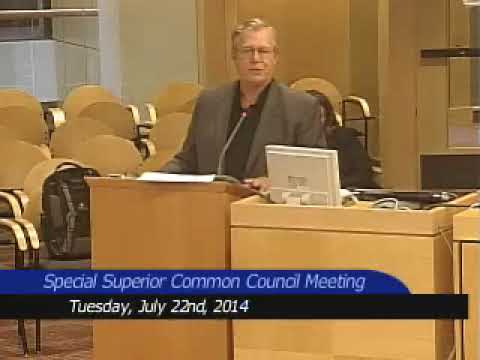
At a special meeting, the City of Superior Common Council directed Carlson Detman Consulting to use an expanded set of comparable communities in its classification and compensation study and to include other suggested jurisdictions, including Douglas County and St. Louis County/Duluth, in the market analysis.
The decision matters because the market sample will shape recommendations about pay scales, recruitment competitiveness and the council's later choices about pay structure and benefit trade-offs. Consultant Charlie Carlson told the council that using a larger sample reduces the chance that a single high-paying employer will skew the results and gives department heads a more reliable basis for comparing jobs.
Carlson, of Carlson Detman Consulting, told council members that roughly two-thirds of the city’s employees are over age 45 and that the firm prefers larger samples: “If you do 18 communities, we might get 10, 12 matches. If we do nine, we might get five or six, and that's not as broad a look as you would do.” He said the firm will combine public- and private-sector data, present both sets of results and let the council decide how to weight them.
Councilors pressed on geography and comparability. Some said communities across the state historically used by the city are substantially larger or economically different; others argued that Duluth and St. Louis County should be included because many workers cross the bridge for jobs. Carlson said he will gather detailed data on pension and postretirement benefits and other differences so the council can exclude any jurisdictions that prove not to be comparable.
The consultant also raised policy choices the council must make later: what labor market to use, what position to take within that market (low/mid/high) and what pay structure to adopt. Carlson said he will present alternatives, likely including a traditional step system and a model with some pay-for-performance elements, but he advised the council that the city currently lacks the training and evaluation systems needed for a full pay-for-performance rollout.
Council members asked about fringe benefits and insurance costs. Carlson noted the city’s relatively high benefit load and warned that unresolved insurance issues could expose the city to federal taxes often described as the “Cadillac tax.” He advised addressing benefit design separately rather than reducing base pay to control total compensation.
The council made a voice-motion to “go along with the comparables that [the consultant has] listed and look at the other ones that have been suggested.” A councilor seconded; the mayor/president called for a voice vote and said “Aye.” The chair declared the motion carried. Carlson said he would proceed to survey and update the larger database and return with results for the council to consider.
Next steps: Carlson will update the firm’s database, seek current pay data from the expanded list of municipalities and from private-sector sources (Bureau of Labor Statistics and Towers Watson surveys were cited as sources), then present findings and alternatives for how the city positions itself in the market and how pay increases could be administered.