Get Full Government Meeting Transcripts, Videos, & Alerts Forever!
Get email alerts on the Tax Increment Financing topic
No spam. Unsubscribe anytime.
Council approves creation of Tax Increment District 13 despite resident objections
Summary
The City of Superior approved a resolution to create Tax Increment District (TID) Number 13, a mixed‑use 20‑year district centered on a proposed waterfront hotel, after a presentation by city staff and a three‑minute public protest from a resident economist.
The City of Superior Common Council voted to create Tax Increment District Number 13, a mixed‑use 20‑year district intended to support a proposed waterfront hotel and related infrastructure improvements.
The council approved a resolution to establish the district after a presentation from city staff and consultant Sean Lance of Ehlers, and after a public comment period in which Dr. Zamira Simpkins, a local economist, urged the council to reject the plan.
City planning staff and consultant Sean Lance told the council that the district boundary would include property around the Bong Center and waterfront and that the primary project the TID is intended to incentivize is a hotel project of approximately 75 rooms. Lance said the project plan assumes a targeted initial taxable value for the hotel development of about $4,800,000 and described financing tools the city would use, including tax increment project revenue bonds, internal advances from city funds to cover park and stormwater work, and a possible later state trust fund loan for a second-phase residential site.
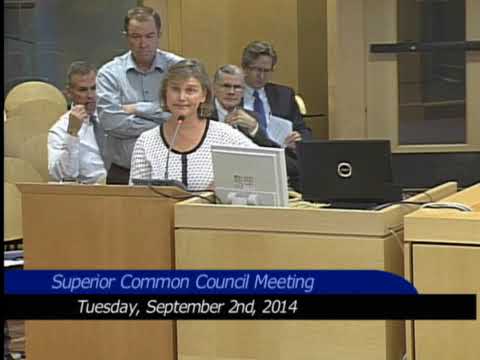
Dr. Zamira Simpkins, who identified herself as “a PhD in economics” and a Superior resident, told the council she represented 118 petition signers and challenged the financial assumptions in the plan. She pointed to language in the report that referenced “tax increment project revenue bonds, municipal revenue obligation, and general obligation debt,” and said that, by her calculation, the city would incur a net present value loss. In part she said: “Please vote no on T‑13 because it doesn't make any sense from the public point of view.”
Councilors asked staff to clarify mechanics: staff and consultant explained that existing taxable property inside the proposed district would remain in the property tax rolls as a base value and that only increases above that base (the increment) would be captured by the district fund and used to repay the revenue bonds or reimburse internal advances. Lance described the revenue bond as a limited‑liability obligation intended to be paid from tax revenue generated by the project site rather than a general obligation of the city.
The council approved the resolution establishing TID Number 13 and also approved related procedural items: a cooperation agreement and transfer of identified properties to the Redevelopment Authority (items considered in the same session). Staff noted a joint review board meeting of taxing jurisdictions was scheduled for later in the week to complete the statutory review process.
The presentation and the council’s action make eligible a range of uses for TIF proceeds outlined in the plan, including property acquisition, development incentives, site work, park and parking improvements, and stormwater projects within the district and up to a half‑mile outside the boundary.
Next steps identified by staff include finalizing a development agreement, the required joint review board meeting with the taxing jurisdictions, and continued refinements to the project plan and financing assumptions.