Get Full Government Meeting Transcripts, Videos, & Alerts Forever!
Get email alerts on the Stormwater topic
No spam. Unsubscribe anytime.
South Berwick hears stormwater update as nitrogen rules, sweeping requirements approach
Summary
An environmental engineer told the Town Council the town’s municipal stormwater permit will grow stricter in 2027, likely bringing new low-impact development standards and nitrogen-reduction measures; councilors later debated buying a combined street‑sweeper/storm‑basin cleaner and voted down a funding transfer.
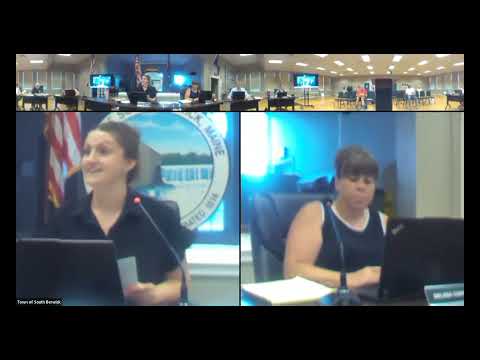
Christy Rubaska, an environmental engineer consulting to the Southern Maine Stormwater Working Group, told the South Berwick Town Council on June 24 that the town’s municipal stormwater program will face stricter state rules when the next general permit is issued in 2027.
Rubaska said the town has been regulated under the general permit for municipal separate storm sewer systems “since 02/2003, and we are now finishing up permit year 3 of our fourth general permit,” and that state low‑impact development standards and new nitrogen requirements are likely to be enforced after the permit renewal process.
The presentation explained why nitrogen is becoming a focus: wastewater treatment plants are being required to reduce nitrogen loads, and one cost‑effective option for treatment plants is to partner with municipalities on land‑based measures such as street sweeping and catch‑basin cleaning. Rubaska said, “street sweeping goes a long way towards nitrogen reduction,” removing leaf litter, dust and deposited material that otherwise washes into catch basins and downstream waters.
Rubaska briefed the council on three near‑term items: (1) a Maine Department of Environmental Protection (DEP) audit of regulated municipalities is likely within one to two years; (2) updated state low‑impact development (LID) standards are expected to be finalized with a 30‑day appeal period, after which South Berwick staff would begin ordinance changes (staff projected work with the planning board in September–November 2025); and (3) growing attention to nitrogen limits in the Great Bay estuary region and the role municipal sweeping and catch‑basin maintenance can play.
Councilors asked practical questions about sweeping frequency and equipment. Rubaska and staff described three sweeping frequencies used in nitrogen‑credit programs: twice a year (the bare minimum for credit), monthly, and twice a month, noting that “anything beyond that is, you know, you're definitely causing more pollution.” Council members asked whether frequent sweeps might themselves create environmental impacts or increased emissions from equipment.
Later in the meeting, councilors discussed whether to use underspent highway operating funds to acquire a used dual‑purpose vehicle that combines a street sweeper with a storm‑basin vacuum (presented by public works staff and the town manager). Supporters said buying the truck now would save recurring contract costs and position the town to meet expected permit requirements; opponents urged more analysis of lifecycle costs, storage and maintenance, and possible hidden expenses.
Councilor Bill moved to transfer surplus highway operating funds into a CIP account and use those funds to buy the stormwater/street‑sweeping vehicle; the motion was seconded and voted 2–2, failing under council rules.
Rubaska and public works staff said the town currently contracts sweeping and basin cleaning at varying frequencies and that the cost and frequency are likely to increase after the permit renewal. The presentation linked the practical choice—contract more service versus buy equipment—to the broader statewide changes in LID and MS4 permit expectations.
The council did not adopt a new sweeping or basin‑cleaning program at the meeting. Staff said they will continue to track Maine DEP rulemaking, the LID standard finalization and the DEP audits, and bring options back to the council for equipment, contract, or schedule changes.
For residents: the DEP audit and LID adoption timeline mean near‑term changes to development rules and municipal maintenance programs could follow once the state’s appeal period closes and the next MS4 permit is issued in 2027.