Get Full Government Meeting Transcripts, Videos, & Alerts Forever!
Get email alerts on the Excavation Safety 811 Outreach topic
No spam. Unsubscribe anytime.
California underground safety board workshop focuses on outreach to reduce failures to notify 811 before digging
Summary
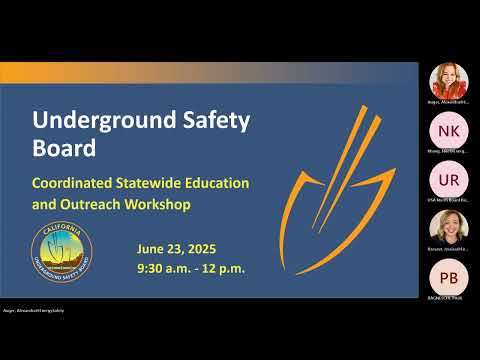
SACRAMENTO — Industry stakeholders meeting in person and online at a statewide workshop convened by the California Underground Safety Board and the Office of Energy Infrastructure Safety spent the day outlining outreach messages and channels to reduce damages caused by failing to notify 811 before excavation.
SACRAMENTO — Industry stakeholders meeting in person and online at a statewide workshop convened by the California Underground Safety Board and the Office of Energy Infrastructure Safety spent the day outlining outreach messages and channels to reduce damages caused by failing to notify 811 before excavation.
The workshop framed the problem with data from the Common Ground Alliance Damage Information Reporting Tool (DIRT) and industry reports, noting that “no locate request” — damages caused by a failure to notify 811 — remains a key root cause. Workshop presenters said calendar trends in 2023 showed the highest number of reported damages in August and the most damages by day of week on Tuesdays; contractor excavators accounted for about 51% of reported damages and the largest work-type category labeled “unknown.” The most frequently named facilities hit included fencing, sewer, landscaping, electric and building construction; organizers also noted increases over a three‑year span in electric and cable-TV damages.
Why it matters: Hitting buried utilities can cause service outages, expensive repairs and safety risks to workers and the public. The board and participating utilities described the workshop as part of a statewide, multi‑year effort to improve education and outreach and to encourage safe excavation practice through clearer, more targeted messaging.
Jessica Reza, chief of education and outreach for the board, summarized the DIRT filters used in the presentation and the definitions organizers used for the workshop. “No locate request represents damages caused by a failure to notify the 811 center,” Reza said, and she asked attendees to keep those definitions in mind as they discussed audiences and messages.
Workshop activities and audience feedback
Attendees worked through a series of facilitated activities focused on identified audience groups: small construction companies, licensed contractors, landscapers/fence contractors and small, single‑crew operators. Common themes emerged across audiences:
- Financial incentives and risk framing. Multiple participants said small firms weigh downtime and immediate job completion against the perceived hassle of a locate request. “Downtime is an issue for them,” said James Wingate of USA North 811. He encouraged messages that compare the short delay of a locate against the larger costs of a damage, including repair costs and fines.
- Reputation and contract access for licensed contractors. Several speakers said licensed contractors are motivated by the need to win and keep contracts from large owners and utilities. One participant recommended tying compliance to bid lists and project qualifications so contractors who do not follow 811 procedures are less competitive for larger projects.
- Practical outreach for transient crews and specialty trades. Fence and landscaping contractors often perform many small, fast jobs and may not view all such work as “excavation.” Participants urged messaging that clarifies that even shallow digging and handheld tools can strike buried facilities and that utility depth is not predictable.
- Education, licensing and permitting touchpoints. Attendees suggested multiple institutional hooks for outreach: contractor licensing coursework and exams, municipal permitting systems that require an 811 ticket or ticket number before issuing certain permits, builders’ exchanges and trade associations, rental-supplier and big‑box retail partnerships, and door‑hanger campaigns tied to meter‑reading or field crews.
On enforcement and training, industry representatives described several approaches they thought could raise compliance over time: including 811 awareness in contractor license training or continuing‑education requirements, using permit systems to require a ticket number before work begins, and promoting voluntary recognition programs such as those tied to a “gold shovel” or other operator/contractor standards.
Selected quotes and examples
James Wingate (USA North 811) emphasized the trade‑off small firms face: “Downtime is an issue for them,” and messaging should show “the risk is higher than the reward of getting the job done.”
Michael Donlin of United Contractors said some contractors still underestimate the repair costs of striking facilities such as fiber: “You get one of those and the cost to repair it would put you out of business.”
Steve Sizemore of PG&E, drawing on investigations and contractor interactions, stressed education plus enforcement: “A lot of the smaller companies don't have a safety manager…being able to have them understand and know these rules… and the enforcement side of things knowing that if you don't comply…there will be a penalty.”
Workshop participants also shared outreach tactics that agencies and operators have found effective: targeted email to opted‑in users, short social videos with strong hooks for social platforms, QR‑code links from long‑form content to short clips, tailored tailgate‑talk materials for jobsite briefings, supplier and rental company partnerships, builders’ exchange outreach, and door‑hanger campaigns in neighborhoods where locates or field work occur.
Data gaps and implementation concerns
Presenters and attendees noted gaps in available data. The Common Ground Alliance report cited at the workshop is voluntary and does not capture every damage; organizers said “no‑ticket” damage is hard to track. Participants also raised specific coverage gaps: work on Caltrans property and along some rail corridors may not be included in some operator locates; older utilities embedded in asphalt or installed before modern records (for example legacy cable TV conduit) can be unmarked and are repeatedly struck; and homeowner‑initiated tickets do not always indicate whether a hired excavator or subcontractor is the responsible party.
Next steps and contact information
Organizers said the committee will analyze the workshop inputs, compile the short messaging suggestions submitted during the session and use the results to guide coordinated statewide education and outreach. Closing remarks from board members invited further input and directed attendees to send additional materials to the committee email provided at the workshop (DickFord@energysafety.ca.gov). The event page and sign‑up information are available at energysafety.ca.gov; the board noted upcoming meetings in July and an annual education and outreach meeting in September.
Ending
Participants left the workshop with a consensus that clearer, audience‑tailored messages — emphasizing financial risk, business continuity and personal safety — and a mix of digital and field outreach tactics (email, short video, permitting hooks, supplier/rental partnerships and door hangers) should be tested and prioritized in follow‑up work by the board and state partners.