
Galena planning commission backs comprehensive plan, adds amendments on emergency services, housing language and access study
Get AI-powered insights, summaries, and transcripts
Subscribe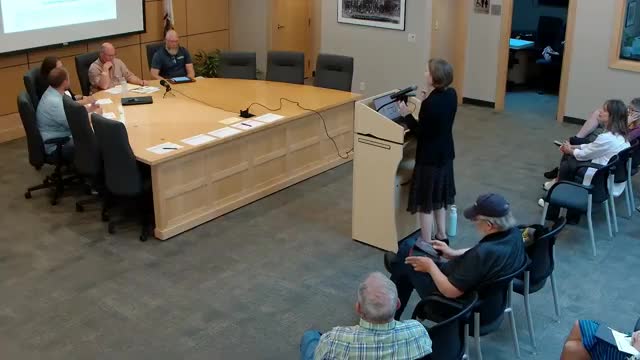
Summary
The Galena Planning Commission voted June 25 to recommend that City Council adopt the updated Galena Comprehensive Plan, after a public hearing and several amendments that add an East‑Side emergency‑services study, revise housing language and ask for a study of secondary access from Blackjack Road to U.S. Highway 20.
The Galena Planning Commission voted June 25 to recommend that City Council adopt an updated Galena Comprehensive Plan, after a presentation by the plan consultant and a public hearing that drew more than a dozen commenters and several amendments to the draft.
The plan consultant, Carrie Papelbon, representing Halsey Levine, presented the draft and summarized outreach and the plan’s structure, telling the commission, "I will be happy to answer any questions." The commission then opened a public hearing in which residents, business representatives and emergency-service officials offered praise, concerns and suggested edits before commissioners voted to approve the plan and four specific amendments.
Why it matters: the comprehensive plan sets the city’s long-term guidance on land use, housing, transportation and public infrastructure and is used to guide zoning changes, capital improvement planning and grant applications. Commissioners described the document as a policy framework that will require follow-up studies and zoning updates to implement specific projects.
What the commission approved
- Recommendation to City Council to adopt the Galena Comprehensive Plan as presented, with amendments (passed by roll-call vote). - Amendment 1: add a recommendation to study emergency-service (EMS and fire) feasibility and delivery on Galena’s East Side (added by motion and approved). - Amendment 2: change phrasing referring to "workforce housing" to less charged language about providing additional/missing‑middle housing types (motion and approved). - Amendment 3: add explicit reference to emergency medical services (EMS) in the emergency-services section and remove wording that could imply only the fire department provides EMS (motion and approved). - Amendment 4: add a recommendation to study a secondary access between Blackjack Road and U.S. Highway 20 (motion and approved).
Public comment and key concerns
Supporters praised the plan’s comprehensiveness and outreach. Adam Johnson, a resident, said he was both "in favor that we're finally getting to this. It's about 15 years late," and voiced support for West‑side development and housing expansion. Ben Petty, speaking with emergency‑service data, urged that EMS be treated as an essential city service and resourced accordingly.
Several residents urged clearer limits on short‑term rentals and on how "transitional residential" is defined. Christine Baxter, who lives in a transitional residential area, told the commission, "Transitional sort of implies you're transitioning to something," and asked for clearer language so that infill and redevelopment priorities do not unintentionally permit large contiguous commercial or accommodation conversions that would change neighborhood character.
Opponents and commenters raised resource and infrastructure questions. Paul Sapera and others asked how projected growth would be supported by water supplies and groundwater planning. Multiple speakers urged the commission to address emergency‑response capacity on the East Side, noting long volunteer response intervals and rapidly rising EMS call volumes cited by local providers.
Planner’s and commission responses
Carrie Papelbon and the consultant team summarized outreach numbers included in the draft: a kickoff and fact‑finding phase, focus groups (51 participants), a business workshop (22 attendees), a community visioning workshop (22 attendees), an online questionnaire with 122 responses and 37 map pins on the public mapping tool, plus more than 40 attendees at a plan open house — overall more than 300 engagement points.
Commissioner Gary (first name given in the hearing) clarified the housing language during discussion: "Workforce housing is intended to provide more of those missing middle options that are available for more income models," and said the commission would accept edited wording if the council prefers a different label.
Next steps and implementation notes
The commission’s recommendation, including approved amendments, will be forwarded to Galena City Council for final adoption. Commissioners and speakers emphasized that the plan itself is advisory: implementing many recommendations will require zoning‑code changes, capital and facility studies, and separate funding decisions. The consultant and staff noted the plan includes an action matrix that assigns priorities, likely partners and suggested time frames (short, medium, long, ongoing) for implementation items.
Documented clarifications from the hearing
- The plan does not itself change the zoning code; it is intended to guide subsequent zoning and ordinance updates. - The commission added a specific recommendation to study emergency‑service (EMS and fire) feasibility on the East Side to address concerns about response times and rising call volume. - The commission approved changing the wording around "workforce housing" to emphasize additional/missing‑middle housing types rather than implying a narrowly defined worker‑only housing product.
What remains unresolved
Speakers requested more detailed water‑resource planning and explicit treatment of large proposed developments that remain contested in other forums. Several commenters called for clearer short‑term‑rental limits and more detailed infrastructure cost analyses tied to specific growth scenarios. Those issues were raised as topics for follow‑up studies rather than items adopted tonight.
A copy of the amended draft will be prepared for City Council review; the commission’s recommendation and the four approved amendments will be included with the submission to council.