
Superintendent warns bill to expand open enrollment could strain Oyster River finances
Get AI-powered insights, summaries, and transcripts
Subscribe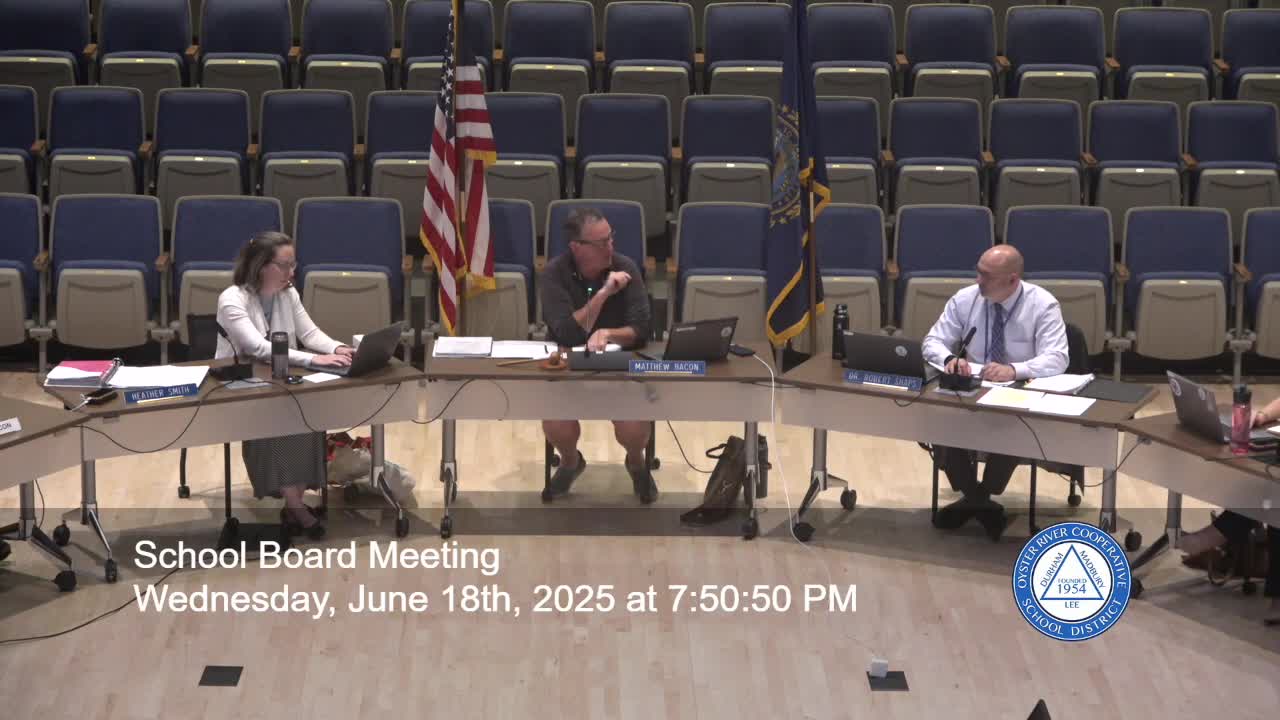
Summary
Superintendent Shapps told the board that a proposed open‑enrollment provision attached to an unrelated bill could require districts to post monthly seat availability and accept out‑of‑district students with 80% of sending district per‑pupil funding, potentially creating budget shortfalls; the board discussed next steps and legal review.
OYSTER RIVER, N.H. — Superintendent Shapps told the Oyster River school board on June 18 that a proposed open‑enrollment provision under active consideration at the state level could have “significant” fiscal and operational impacts if enacted quickly.
Shapps described recent committee activity that attached an open‑enrollment provision to a cyberbullying bill and said conference‑committee maneuvering raised the possibility the provision could reach the governor’s desk. He said if adopted with an immediate effective date the change “would be significant if it was an immediate decision relative to this bill becoming active for the 25‑26 school year.”
Shapps described multiple concerns: local school boards set class sizes and raise taxes for local students, but the bill’s mechanics could force districts to accept out‑of‑district enrollments and report capacity monthly. He further explained the draft funding approach would transfer roughly 80% of the sending district’s per‑pupil amount to the receiving district. As an example discussed at the meeting, if a sending district’s per‑student amount is $8,000, the receiving district would get about $6,400 per incoming student.
Finance committee members and the superintendent raised specific local consequences. The finance chair noted Oyster River has an existing tuition agreement with Barrington; Amy (district finance staff) said the district expects roughly $3,100,000 in revenue tied to that agreement and warned the open‑enrollment formula would “have a dramatic impact” on the district’s ability to continue that arrangement.
Board members and administrators also discussed special education, transportation and capacity logistics: Shapps offered an example in which influx students could require additional bus routes and staff after budgets were finalized, and asked where sudden additional transportation costs would come from. He said legal and budgetary questions remain unresolved and predicted the governor would need to decide whether to sign the measure.
Shapps also briefed the board on two other state actions: an HB2 provision under consideration that would restrict some DEI‑related contracting and programming, with potential unintended consequences for services to students with disabilities; and the new universal voucher program now on the governor’s desk, which Shapps said was funded initially for 2,500 students though proponents mentioned a 10,000‑student target.
The board discussed options for response. Shapps said he had joined colleagues drafting an op‑ed opposing immediate consideration and would participate in legal consultations (with the ACLU) the week of July 7 to clarify likely impacts. Board members discussed the prospect of short‑notice July meetings to respond to any rapid developments and suggested coordinating with statewide school board associations. No board vote was taken; members discussed drafting resolutions for the New Hampshire School Boards Association (NHSBA) and engaging in advocacy.
Ending: Administrators said they will monitor the legislation closely, participate in legal briefings in early July, explore emergency meeting options if statutory timelines require immediate action, and work with NHSBA and other districts to coordinate responses.