
Huntersville planning board recommends denial of Holbrook Phase 2 rezoning after neighbors raise tree, driveway and traffic concerns
Get AI-powered insights, summaries, and transcripts
Subscribe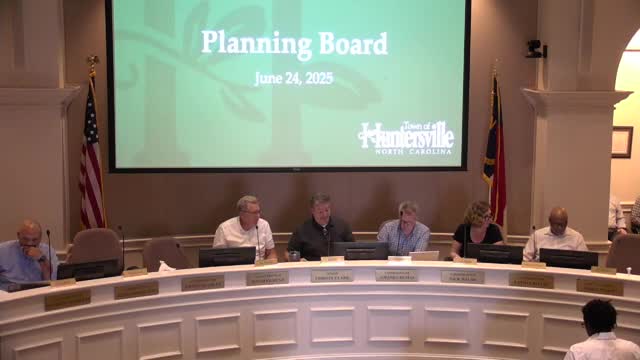
Summary
The Planning Board voted to recommend denial of a rezoning request for a 1.7-acre mixed-use building on Gilead Road after neighbors and several board members raised concerns about reduced buffers, driveway placement and deferring a traffic impact analysis.
The Huntersville Planning Board on Monday recommended denial of petition R25-04, a rezoning request by North State Development for about 1.7 acres at 106 Gilead Road to allow a mixed-use building with up to 55 residential units and ground-floor commercial.
Neighbors and several board members said the current conditional rezoning plans reduce the required buffer along an adjacent single‑family property, put a driveway closer to existing homes in one option, and would defer a traffic impact analysis in exchange for a $15,000 payment toward a future downtown transportation study.
The request would change the site from Neighborhood Residential (NR) to Town Center Conditional District (TCCD). Staff said the developer submitted two alternative site plans: “Plan A” shows a shared driveway with the neighboring 760 Craftworks parcel and is staff’s preferred design for pedestrian and circulation reasons; “Plan B” places the driveway on the west side of the building and is the developer’s backup if they cannot reach an agreement with the adjacent property owner. Planning staff said the submitted building footprint was increased to 17,000 square feet and that the maximum residential total on the lot would remain 55 units (about 31.8 units per acre).
Resident Jerry Ingalls, who said he and his wife purchased their house in 1997 and raised a large family there, urged the board to delay action and require the applicant to return with a single plan that respects existing vegetative buffers. “We have 3 objections,” Ingalls told the board. “One of the plans has the driveway right down between our house and this. We’re trying to imagine hundreds of cars every day running up and down that driveway.” He also said the plan in the packet shows a 10-foot buffer where the code calls for 40 and warned the narrower buffer would risk losing mature trees.
Planning staff recommended several modifications and conditions if the board approved the rezoning, including a clearer pedestrian path with an 8-foot clear zone, stronger building articulation on upper levels, and a larger buffer—staff suggested 20 feet rather than 10 to better protect mature trees. Staff also noted the proposal fits many elements of the town’s 2040 Community Plan and the 2023 downtown master plan that encourage downtown mixed use and vertical mixed-use buildings, but that portions of the downtown plan also identify areas for potential open-space expansion that are not consistent with the proposal.
On the traffic question, the applicant requested a modification to the town’s traffic impact analysis (TIA) requirement: instead of running a site-specific TIA and then doing mitigation, the applicant proposed donating $15,000 to a town-initiated comprehensive downtown transportation plan that staff and the town budget anticipate initiating next year. Staff and several board members said it is uncommon for the town to approve rezoning without a completed TIA; staff said the engineering department normally expects a TIA to be provided before final action. The applicant said a full TIA could cost more than their donation and that, based on prior studies of the area, the project’s proportional mitigation need might be in the range of $20,000 if a mitigation measure were required.
Developer Rachel Krenz, the project’s development manager, told the board the applicant prefers Plan A (the shared driveway) because it produces a better pedestrian experience and gives the team more land to work with, but that Plan B is necessary as a financing and fallback option so the property can be purchased if an agreement with 760 Craftworks is not reached. Krenz described steps the team has taken to preserve the largest trees along the shared property line, including hiring an arborist and a construction tree‑protection specialist.
Board members discussed whether the application was ready for a recommendation. Several said the package was close but had too many unresolved details—especially around the driveway configuration, the buffer/tree protections, and the TIA waiver—to forward a recommendation of approval to the Town Board. Board member Pollard moved to recommend denial; after a second and discussion the motion passed with no recorded dissent, carrying the board’s recommendation to deny the rezoning.
The applicant and staff can return with revised materials or a single plan if they wish to pursue the rezoning further before the Town Board.
Less-critical details: staff noted they would like more specific information about the proposed commercial square footage calculation (the ordinance currently requires 60% commercial on the first floor, and the applicant seeks to count shared back-of-house space differently), clarification on building elevations and pedestrian realm details, and a firm scope for any mitigation or tree‑preservation plan.