Get Full Government Meeting Transcripts, Videos, & Alerts Forever!
Get email alerts on the Surveillance Alpr Flock topic
No spam. Unsubscribe anytime.
Evanston police disable national Flock lookup, limit out-of-state sharing after misuse reports
Summary
After reports of out‑of‑state misuse of Flock Safety’s license‑plate lookup tool, the Evanston Police Department disabled the national lookup and restricted data sharing to Illinois agencies; the council and public pressed for stronger local rules and an ordinance protecting health data and immigration status.
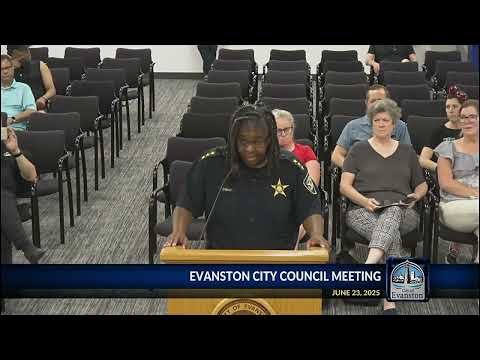
The Evanston Police Department has disabled the national lookup function of its Flock Safety automatic license plate reader (ALPR) account and blocked out‑of‑state access to its data while the vendor works with Illinois officials, Chief Stewart said at the City Council meeting June 23.
The move is part of a set of administrative changes the department described to the council amid community concern that ALPR data could be used by out‑of‑state law enforcement to locate people seeking reproductive health care or immigration enforcement. Chief Stewart said the department will limit Flock data sharing to Illinois agencies, require written approval by both the police chief and the city manager before adding any new agency, and has disabled the platform’s national search tool.
The changes follow a departmental review after reports that a small number of agencies using Flock conducted searches that violated Illinois House Bill 3326, the state law governing ALPR use. Sergeant Tom Giese, who oversees ALPR operations for the Evanston Police Department, told the council the department has 18 stationary Flock cameras and one mobile unit and that the system has helped investigators identify vehicles and locate victims and suspects. “This ALPR system has proven instrumental in supporting public safety not only in Evanston, but nationwide,” Giese said.
Why it matters: Council members and several public commenters said they remain concerned that even limited sharing can cascade beyond the city and that municipal controls may not prevent federal subpoenas or other lawful demands for data. Public commenters urged the city to restrict or end the use of surveillance technologies altogether and to adopt strong local protections for health‑care‑related data.
What the department says it found and will change Sergeant Giese said Flock searches have helped Evanston investigators recover about 100 vehicles, identify more than 80 vehicles involved in crime and contributed to roughly 60 arrests tied to property crimes, violent offenses and hit‑and‑runs. The department told the council it used Flock in investigations ranging from homicides to carjackings and missing‑person cases.
Giese said Flock identified 47 out‑of‑state agencies and 290 nationwide queries that violated Illinois law across the company’s network; the department emphasized those 47 agencies represent a small fraction of Flock’s roughly 6,500 agency customers. The department also said it found no evidence that any Illinois agency, including Evanston, had shared ALPR data to locate people seeking reproductive health care.
Chief Stewart said the department immediately updated policies after Illinois enacted HB 3326 in January 2024 and provides quarterly audits and supervisory review of ALPR use. "At no time ALPR data should be used for immigration enforcement or reproductive health purposes," he said, describing layered oversight and disciplinary protocols.
Council reaction and public comment Council members expressed a range of concerns: some said the changes were an appropriate first step, while others urged a permanent end to national sharing and stronger local safeguards. Council member Burns said disabling the national lookup was necessary and that he “cannot envision a universe where… switching on the national lookup seems remotely, appropriate.” Council member Haddakaddis (place name in transcript) said she remained uncomfortable with corporate assurances and the possibility that data could be re‑shared by another Illinois agency.
Public commenters pushed the council to go further. David Sutherland, speaking during the public‑comment period, said: "Evanston cannot be a welcoming city and a surveillance city at the same time," and called for terminating the Flock contract. Sarah Garza Reznik, president and CEO of PersonalPAC, urged the council to pass a health data protection ordinance that would bar sharing sensitive health information with jurisdictions enforcing abortion or gender‑affirming care bans.
Next steps and limits of local authority City staff and the police chief told the council they welcome drafting a local ordinance to align ALPR policy with Evanston’s values and cited ongoing work by the Illinois attorney general and the state secretary of state with Flock. Corporation Counsel Alex Ruggier said he would review the vendor contract if the council wanted to explore termination; he reported his initial review did not identify a contract violation by Flock specific to Evanston.
Officials also noted limits on municipal authority: Corporation Counsel Ruggier and other speakers reminded the council that a valid court order or federal demand could require the city to turn over data even if the city does not share it voluntarily.
What the council did on June 23 The council did not vote on banning ALPRs or terminating the Flock contract at this meeting. The police department’s administrative changes — disabling national lookup and blocking out‑of‑state access, limiting data sharing to in‑state partners, and requiring dual written authorization for new agency access — were described by department leadership as internal policy actions taken by the department and city manager. Multiple council members asked staff to bring a more formal review and possible ordinance back to the council for deliberation.
Votes at a glance (items acted on during the meeting) • Approval of virtual participation for Council member Periel Davis — motion passed (7–0). Mover: Council member Newsom; seconder: Council member Harris. • Consent agenda (minus items A3, A8, FB1) — approved (8–0). • Contract award: 2025 Alley and sidewalk improvements (Alliance Contractors) — approved (7–1). Council member Kelly voted no; mover: Council member Kelly; seconder: Council member Harris. • Contract award: Robert Crown athletic field fencing repairs (National Sports Nets LLC) — approved (8–0). • Resolution 58‑R‑25 (FB1) — approved after motion to refer back to Finance and Budget failed (resolution passed 7–1). • Motion to convene executive session under the Open Meetings Act, 5 ILCS 120/2(c), to discuss litigation — approved (8–0).
The city manager and police department said they will return with more formal options, including possible ordinance language and specifics about the agencies currently allowed to access Evanston’s Flock account. The council and community members signaled they expect a focused hearing and more public input before any decision on contract renewal or termination.