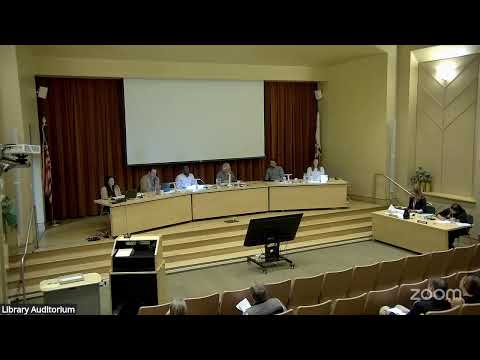
Orinda Planning Commission continues review of 14 Los Altos home after neighbors, commissioners raise design and tree-protection concerns
Loading...
Summary
Commissioners deferred a decision on a proposed 4,001 adjusted-square-foot home at 14 Los Altos Road after neighbors and some commissioners questioned the building’s massing, proximity to a protected oak and compliance with ridgeline overlay rules; the applicant agreed to return at a date uncertain.
The Orinda Planning Commission on June 24 continued consideration of a proposal to demolish a dilapidated house at 14 Los Altos Road and build a new 4,001 adjusted-square-foot single-family home after commissioners and neighbors raised questions about design, size, and protection of a nearby oak tree.
Staff told the commission the project proposes a 4,001 adjusted-square-foot residence (4,401 gross square feet with a 400-square-foot garage credit), a 559-square-foot elevated deck and a 749-square-foot accessory dwelling unit that is not counted toward the maximum floor area. The lot is 20,020 square feet with an average slope of about 27 percent; because the parcel lies in the Ridgeline Overlay District, the proposal triggers discretionary design review and special design review under the Orinda Municipal Code.
Planning staff recommended approval, presenting project plans, site maps and a table comparing nearby homes. Staff said the project meets the base development rules for the RL-20-R district but exceeds the overlay thresholds (500 square feet and 18 feet in height), and therefore requires design review and special design review. Staff noted stormwater would be collected in underground piping and a subsurface trench at the rear of the lot, that no trees are scheduled for removal and that building permits will be routed to county grading and drainage reviewers. Staff also identified project-specific conditions, including resolution of geotechnical peer-review comments (referenced as comments from Ninyo & Moore) before issuance of a building permit and a required construction management plan to mitigate temporary traffic impacts.
Neighbor John Hanson, who lives at 10 Los Altos Road, said he welcomed development of the long-abandoned parcel but asked the commission to protect a large oak tree, which he called "beautiful," and asked that the new structure be pushed further from his property. "That tree is beautiful. It's 2 feet from the property line, provides amazing beauty, shade, habitat for us," Hanson said, and asked the commission to require stronger safeguards and monitoring during construction.
Applicant representatives said they had modified the project after neighbor feedback. Dustin Boyce, the applicant’s representative and general contractor, said he had worked with the owner and city staff since September 2024 and that the tree-removal request had been withdrawn. Jeff Moore of Greenwood & Moore Engineering described design constraints imposed by fire-department requirements and topography: the house location was chosen to minimize grading and meet the Moraga-Orinda Fire District's (MOFD) limits on driveway slope and maximum fire-hose distance. Moore said the team engaged an arborist and would implement tree-protection measures during construction. "We think we've done a nice job. We think it's a beautiful home. We don't think a 4,000 square foot home is inappropriate in Orinda," Moore said.
Several commissioners expressed concern about the house’s perceived massing and about an uninhabitable attic-like space above the front of the house. One commissioner proposed adding a condition requiring recorded documentation that the attic space remain uninhitable; commissioners also sought clarity on how the design could be altered without violating MOFD constraints. The applicant offered to record an affidavit limiting conversion of the uninhabitable space if the commission required it.
After a motion to approve the staff recommendation with an added condition identifying the uninhabitable space was made and a roll-call vote taken, the chair and staff identified a counting error in the roll call and said the earlier approval did not stand. The applicant agreed to continue the application to a future, unspecified hearing date. Commissioners then unanimously approved a new motion to continue the item to a date uncertain.
Next steps: the application will return to the Planning Commission at a future meeting for further consideration. Staff noted that the decision is appealable to the City Council if a written notice of appeal with appropriate fees is filed within 10 calendar days of a final commission decision, and reminded attendees that if the decision is later challenged in court the issues the court may consider are generally limited to those raised at the public hearing or in written correspondence to the commission. Geotechnical peer-review comments and any required tree-protection plan will need to be addressed before building permits are issued.