Get Full Government Meeting Transcripts, Videos, & Alerts Forever!
Get email alerts on the Budget Finance topic
No spam. Unsubscribe anytime.
Lafayette staff flag slowing revenue growth, launch fee and utility rate reviews
Summary
City finance and public‑works staff briefed council on economic uncertainty, flat sales tax, reassessment impacts, a parks/recreation fee study and an ongoing utility rate review; staff will return with fee proposals and rate options during the budget process.
City of Lafayette staff told council the national and state economic outlook remains uncertain and that local revenues are stabilizing after recent years of strong growth, prompting the city to launch several studies and to prepare conservative 2026 budget options.
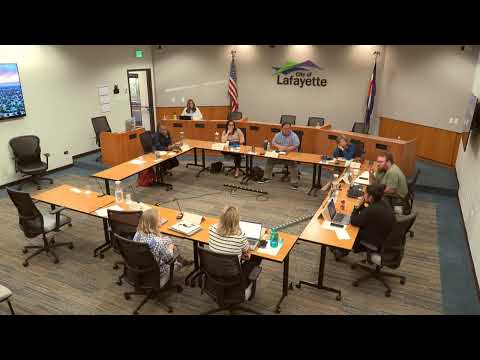
Interim finance staff and department directors presented a budget kickoff that highlighted national and Colorado economic indicators, preliminary reassessment results from Boulder County, and near‑term revenue expectations for the city’s general fund and utilities. Interim chief financial officers Sarah Kolsa and Morgan Walton and Public Works Director Jeff Arthur joined City Manager Dolming for the briefing.
Why it matters: The presentation framed a slow‑growth scenario for Lafayette revenues and identified areas where the city will seek efficiencies and, where necessary, changes in fees or rates. City staff initiated a parks, recreation and golf fee study and a utility rate review; both efforts could lead to fee or rate adjustments to maintain service levels and fund capital and maintenance needs.
Staff summarized state and national indicators, noting that forecasters see elevated uncertainty. "We titled this a time of uncertainty," interim CFO Sarah Kolsa said at the start of the economic briefing. Kolsa and others described a Colorado economy that has slowed from the rapid growth of recent years; local forecasts show moderated home‑price gains and relatively flat taxable sales in 2023‑24 compared with earlier periods.
On local revenues, staff said sales and use tax produced approximately $27.4 million in 2024 and accounted for about 45% of general government revenue; staff do not expect large sales‑tax gains in 2025–26. Property‑tax revenue rose sharply in 2024 because Boulder County performed a reassessment year; staff reported property‑tax receipts of about $15.2 million in 2024, an increase of roughly 25% from 2023. Preliminary, uncertified Boulder County assessment data staff received for 2025 indicate a smaller increase (staff cited roughly 4% preliminary growth) and staff said 2025 is a non‑reassessment year for the county.
Staff outlined two near‑term policy initiatives: a parks, recreation and golf fee study to update cost‑recovery policies and recommended fee changes (any proposed fee adjustments would be presented during the budget process and, if approved, could take effect Jan. 1, 2026), and a clarified fee‑approval process that would retain council approval for fees tied to public peace, health and safety while allowing city management to update administrative and cost‑recovery fees for core services.
On utilities, Public Works Director Jeff Arthur described the sector’s capital intensity and sensitivity to weather and usage patterns. Staff reported that water is the largest enterprise fund and that revenue fluctuates with seasonal outdoor use; the city’s recent rate structure added higher upper tiers to better allocate peak summer costs. Arthur noted an upward trend in delinquencies and said the utility rate study will consider equity and customer protections in potential rate changes. He illustrated infrastructure costs with recent repairs and program numbers: "It probably works out to in the ballpark of $10,000 a foot" for emergency, night‑time main repairs versus about $200 a foot for planned proactive main replacement, he said.
Staff also flagged a number of long‑running utility projects and legal or cost uncertainties — including a high‑cost water supply matter staff referenced as a group project that recently required a $100,000,000 settlement and a planning estimate in the billions for the larger project — and told council they will evaluate options such as adjusting development‑related charges, refining rate structures, deferring noncritical capital and strengthening asset‑management programs.
No immediate rate or fee increases were adopted at the workshop. Staff said they will continue internal budget work, return in August with a more detailed revenue and expenditure outlook and present formal budget and fee proposals during the fall budget hearings. The parks, recreation and golf fee study is underway; staff indicated any recommended fee changes would be proposed during the 2026 budget process with potential implementation on Jan. 1, 2026.