Get Full Government Meeting Transcripts, Videos, & Alerts Forever!
Get email alerts on the Comprehensive Planning topic
No spam. Unsubscribe anytime.
Evanston council hears hours of public comment, stays divided over housing language in draft comprehensive plan
Summary
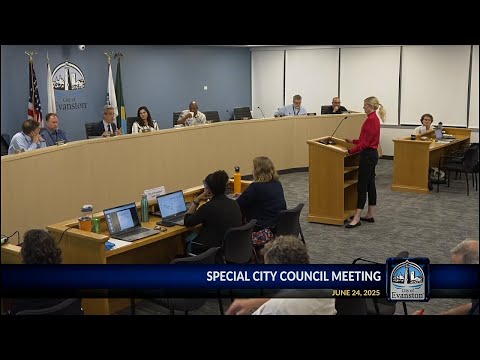
Evanston City Council convened June 24 for a marathon public‑comment session and initial council deliberation on the draft Envision Evanston 2045 comprehensive plan, hearing about 65 people in person and dozens more online before staff began an interactive presentation.
Evanston City Council convened June 24 for a marathon public‑comment session and initial council deliberation on the draft Envision Evanston 2045 comprehensive plan, hearing about 65 people in person and dozens more online before staff began an interactive presentation. The council voted twice on meeting procedures early in the evening: it allowed two members to participate virtually, rejected a motion to give each speaker three minutes and later suspended a 45‑minute cap so everyone who signed up could speak.
The June meeting focused on housing, with speakers, housing advocates and council members sharply divided over whether the draft should explicitly encourage more housing density — including language that some commenters and commissioners described as enabling “missing middle” housing — or prioritize preservation, anti‑displacement measures and permanent affordable housing.
Why it matters: the comprehensive plan is a 20‑year policy document that will shape future zoning, development priorities and city investments. Changes to language in Chapter 10 (Housing), the section on neighborhoods and centers and the plan’s implementation steps will affect how the city approaches upzoning, protections for existing affordable units and the role of developer‑led market housing versus permanently affordable models such as community land trusts.
Public comment themes and excerpts
Speakers opposing large‑scale upzoning and calling for stronger anti‑displacement policy were a consistent presence. Steve Test of the Evanston Action Coalition criticized language in early drafts that he said “called for elimination of single family home zoning and allowing, building by right up to 4 units,” adding that “the worst of that language has been removed,” but urging staff to remove further references tied to the broader “missing middle” movement. Paul Breslin and Meg Welch argued that increasing market‑rate supply alone would not make Evanston affordable: “If Evanston aims to make housing affordable for its lower income residents... it must protect some housing from the market,” Breslin said; Welch urged the council to make “creating permanent affordable housing” central to the plan.
Other commenters pressed the council to protect existing housing stock. Several speakers cited the plan’s own figures showing that “middle housing” constitutes roughly 38% of the city’s housing stock, and argued that new middle‑scale construction often replaces lower‑cost single‑family homes with higher‑priced units rather than producing lasting affordability. Linda Damashek, a longtime local nonprofit housing developer, urged the city to use community land trusts to create permanently affordable units.
Speakers who supported changes to zoning to expand housing options said that limiting single‑family zoning perpetuates exclusion. Sam Pascal and other speakers asked the city to remove or reduce parking minimums and cited academic studies and local examples showing that building parking increases car ownership and development costs.
Council discussion and staff questions
City staff and several council members framed a set of decision points for council guidance in July, including whether the plan should contain an explicit population projection. Staff cited the Chicago Metropolitan Agency for Planning (CMAP) municipal allocation that forecasts a 7.3% population increase in Evanston by 2045, “which equates to a population increase of approximately 600 people,” and asked whether council wanted that projection included in the final draft and how to explain its limits.
Council members also debated whether the plan should include a “centers and corridors” map that identifies appropriate locations for higher‑density or mixed‑use development near transit stations and along specified commercial corridors. Several councilors supported a map to give clarity to later zoning work; others warned that corridors are heterogeneous and that bus routes can change, so guidance should be calibrated to durable transit assets.
Design review and community input
Council discussed creation of a new urban design commission or stronger design review capacity. Supporters said a public, standing design commission could provide early‑stage guidance to developers and residents; skeptics warned against adding another formal review body that might duplicate or conflict with the Land Use Commission or Historic Preservation Commission and urged consideration of strong, transparent design guidelines instead. Council member comments and staff said suggestions and draft text are available in the packet and in an ongoing Google document for council edits.
Housing language: “preserve” versus “increase” and the strategic housing plan
A central, contested line in the draft is the paired phrase “preserve and increase Evanston’s diverse housing choices.” Commissioners and council members differed over what “preserve” should mean (protecting existing affordability and naturally occurring affordable units, rightsizing demolition/rehab incentives) and what “increase” should mean (allow more units by right, change lot or dwelling‑size minimums, or focus only on specific centers/corridors). Multiple council members and public speakers urged completion of a separate strategic housing plan — with targeted data, unit‑type goals and anti‑displacement policies — before adopting prescriptive zoning changes. Council members asked staff to prepare variants of the housing text so council can weigh three options at the next meeting: the pre‑LUC prescriptive language, the LUC‑modified language and an intermediate wording that narrows ambiguity.
Parking, transit and neighborhood impacts
Council members and public commenters repeatedly linked any increase in density to transit capacity, street design and parking policy. Staff offered to bring data from the city’s parking study and to show past development parking usage to inform what “right‑sizing” parking minimums would look like. Speakers advocating for fewer parking minimums argued that parking is costly and that bundling parking raises rents; opponents said some neighborhoods still face real parking pressure from events, institutions and existing development.
Other items and takeaways
- Staff asked councilors to check ward descriptions and provide edits in the shared Google document by July 3; staff will compile responses for the next council meeting and the next formal draft schedule (the LUC materials referenced July 21 for additional deliberations). - Several speakers and some council members asked that the strategic housing plan be completed and used to guide zoning changes rather than adopting final zoning‑related goals in the comprehensive plan. - The draft preserves multiple references to anti‑displacement but council members and public commenters repeatedly said the plan lacks binding anti‑displacement actions such as permanent affordability mechanisms, land trust acquisition strategies, eviction protections or property‑tax relief for long‑term homeowners.
Votes at a glance
- Motion to allow virtual participation by Council members Harris and Davis (mover: Council member Nussbaum; seconder: Council member Herakaris). Vote recorded by roll call; "Aye" votes recorded; clerk announced “6 voting in favor and none voting against.” Outcome: approved. - Motion to suspend rules so each public speaker would receive three minutes (mover: Council member Kelly; seconder: Council member Rogers). Roll‑call vote produced three in favor and five against; clerk announced “With 3 voting in favor and 5 voting against, the motion fails.” Outcome: failed. - Motion to suspend the 45‑minute cap on public comment and give two minutes to each person on the sign‑in sheets (mover: Council member Rogers; seconder: Council member Kelly). Clerk announced “With 8 voting in favor” the motion carried. Outcome: approved.
What happens next
Staff asked councilors to enter written guidance in a shared Google document by July 3; the next step is a July meeting where staff will present compiled council direction and draft language to be used in the next public meeting and in preparation for zoning conversations later in the process. Several council members asked staff to prepare population‑projection context, a centers/corridors map option, parking‑minimum options informed by the parking study, and three alternative housing language tracks for council consideration.
Attribution of direct quotes
Quotes in this article come from council members and public commenters recorded in the city council transcript for the June 24 meeting. Speakers quoted include Steve Test (Evanston Action Coalition), Paul Breslin, Meg Welch, Linda Damashek, Sam Pascal and others who spoke during the public comment period; the transcript and time stamps are provided in provenance.