Get Full Government Meeting Transcripts, Videos, & Alerts Forever!
Get email alerts on the City Budget topic
No spam. Unsubscribe anytime.
Nampa releases proposed FY2026 budget, flags levy limits and wastewater debt payments
Summary
City of Nampa Chief Financial Officer Doug Racine presented a proposed FY2026 budget that holds most operational spending flat, accounts for rising health‑care and energy costs, and plans debt service for the new wastewater treatment plant under a low‑interest DEQ loan.
Chief Financial Officer Doug Racine presented the City of Nampa’s proposed fiscal year 2026 budget at a public council presentation, outlining plans to hold operational spending flat, absorb rising health‑care and energy costs, and continue debt service for the recently completed wastewater treatment plant.
Racine said the administration asked departments to hold operational budgets to “0% cost” after achieving about a 4.5% reduction last year, while identifying unavoidable increases such as insurance, energy and maintenance tied to the new treatment plant. “The budget in the city is our legal authority to spend,” Racine said, adding that staff want to tighten capital budget accuracy and shorten the six‑month budget process.
The proposal emphasizes three priorities identified in the city’s community survey: public safety, transportation and improving movement through Nampa. Racine said the police budget is the single largest line in general government, and cited state legislative changes and rising property valuations as drivers shaping levy calculations and revenue availability.
Why it matters: the budget determines how the city funds police, streets, utilities and capital projects and sets the levy and fee framework for the coming year. Racine warned that state policy changes have reduced revenue from new construction, forcing the city to use the full 3% levy increase allowed by state law to meet ongoing service costs.
Key details from the presentation:
- Revenues and funds: Racine described city finances by fund type: general government (police, mayor’s office, finance, IT), enterprise funds (water, wastewater, sanitation, airport, golf), internal services (fleet, utility billing), and special revenue funds (cemetery, library, parks). He said enterprise funds total roughly $133 million and general government about $69 million in the proposed budget.
- Property taxes and levy: Racine said property taxes represent about 15% of total city revenues but about 54% of general government funding. He presented a levy rate example (reported in the presentation as about 0.002743) and explained that rapid increases in property valuations in recent years have driven levy rates down even as collections from new construction were limited by state legislation (referred to in the presentation as House Bill 389). Racine said the city is now taking the full 3% levy increase allowed by state law to keep pace with costs.
- Wastewater treatment plant and DEQ loan: Racine said the new wastewater treatment plant was completed essentially on or under budget and that the Idaho Department of Environmental Quality (DEQ) provided a low‑interest loan at 1.68% to fund construction; the city must now pay the resulting debt service from the wastewater fund.
- Costs and savings: The budget shows a $1.4 million increase in total health‑care costs for FY2026. Racine broke that down as increases from new hires (including police), premium increases and midyear status changes. He also reported operational expense reductions of about $2.3 million (excluding personnel and debt) and a $4.2 million decrease in capital budgets compared with the prior year, largely because the wastewater project moved from construction to debt service and maintenance.
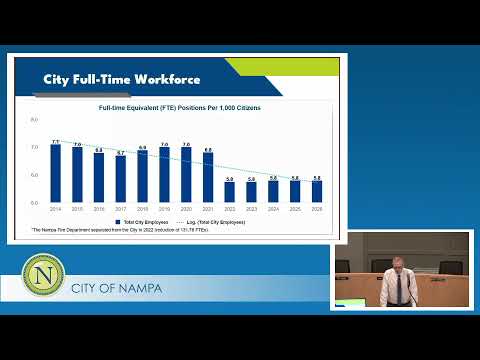
- Staffing and FTEs: Racine said Nampa’s full‑time equivalent (FTE) count per 1,000 residents has remained roughly steady even as population has grown; the presentation noted a population projection rising from about 84,000 in 2014 to roughly 127,000 by the end of 2026. Racine said planned staffing increases are focused on police and public‑works trades to build in‑house capacity and avoid higher outsourced construction costs.
- Budget process and public participation: Racine outlined next steps: councilor budget workshops (presentations by departments) scheduled for mid‑July, a public comment period on August 13, a public hearing and formal adoption likely at the August 18 hearing, and an effective date of Oct. 1, 2025 for the new budget. He noted the proposed budget book and slides are available online via a QR code and that a public display will be set up in the lobby for review.
Quotes and attributions in this article come from two speakers during the presentation: Mayor Miller (opening remarks) and Chief Financial Officer Doug Racine (budget presentation). Direct quotes are limited to statements appearing in the meeting transcript.
Ending: Racine encouraged public review and attendance at the August hearing and asked residents to submit comments through the mayor’s office or the clerk’s office before the adoption date.