Get Full Government Meeting Transcripts, Videos, & Alerts Forever!
Get email alerts on the Urgent Transportation topic
No spam. Unsubscribe anytime.
Charlottesville moves urgent-transportation list toward council; quick-build status, design and fire approvals still unresolved
Summary
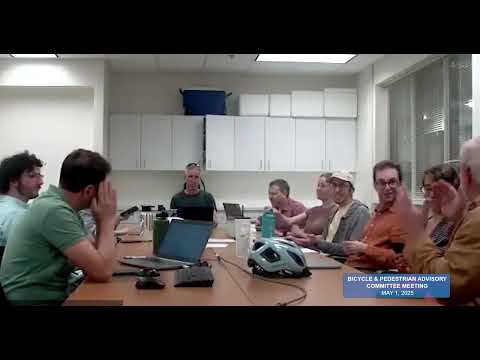
Charlottesville officials told the Bicycle & Pedestrian Advisory Committee that a large package of “urgent transportation” projects compiled after a fatal crash on Elliott Avenue will be presented to City Council for funding, but committee members pressed staff this week for clearer status updates, design responsibilities and agency approvals.
Charlottesville officials told the Bicycle & Pedestrian Advisory Committee that a large package of “urgent transportation” projects compiled after a fatal crash on Elliott Avenue will be presented to City Council for funding, but committee members pressed staff this week for clearer status updates, design responsibilities and agency approvals.
City staff said the list — roughly the size of dozens of projects compiled over recent months — will be presented to council on May 19 for appropriation and that projects will enter Public Works’ work queue if approved. Committee members and staff said progress has slowed because some projects require more design work than previously expected and because the Charlottesville Fire Department must sign off on some traffic-calming designs.
The discussion matters to residents because the package includes a mix of treatments — speed tables, mini-roundabouts, rapid‑flashing beacons and curb bump‑outs — intended to reduce severe crashes and to be tested in multiple neighborhoods. Committee members pressed staff to make clear which items remain active “quick‑build” efforts, which are in Public Works’ separate queue, and which are being folded into the new urgent‑transportation program.
Staff said the urgent list grew from a post‑fatality directive and includes projects recommended by multiple departments, consultants and community feedback. “We compiled a pretty extensive list,” a staff presenter said, noting that staff ranked projects, estimated costs and then adjusted the set to match available funding. Staff described coordination with Public Works and said Ben (staff) will present the list to council to appropriate funding. Staff also said Public Works has begun some installations in the field but paused further work pending internal approvals and additional design detail.
Committee members and neighborhood volunteers said they want clearer public documentation. Several requested that staff add links to the public spreadsheets and label the “phase 1 / phase 2” quick‑build lists used earlier, so members and residents can see what has been built, what remains in queue and what has been reclassified into urgent projects.
On design and construction, staff described two pressures: (1) some projects can be handled quickly with “field‑level” low‑planning decisions and in‑house crews using flex posts and striping; (2) other treatments — e.g., speed tables or mini‑roundabouts — require engineering work to meet turning‑radius, MUTCD and fire‑department constraints. The new traffic engineer, Caleb, and Public Works staff are working to determine which projects can move forward with in‑house, low‑plan methods and which require fuller design packages or outside contractors.
Committee members asked whether urgent‑transportation projects will be queued alongside Public Works’ existing assignments. Staff said that, if council appropriates funding and the fire department has approved designs, projects will be entered into Public Works’ queue and prioritized along with other Public Works work based on crew availability, geography, materials and seasonality.
Members also urged the city to define a programmatic “quick‑build” standard — a written definition of what counts as a quick build, how long a temporary installation should stay in place before being evaluated, what evaluation metrics will be used and how projects transition to permanent treatments. Staff agreed to work toward a clarified definition and to provide clearer status headings in future staff updates.
Next steps identified at the meeting included the staff presentation to City Council on May 19 and additional coordination between the city’s traffic engineering, public works and fire departments to finalize designs and approvals. Committee members asked staff to post materials for the council meeting as soon as they are available and to flag which urgent‑transportation items originated in BPAC’s earlier quick‑build lists.
Ending: Staff and committee members agreed that more public transparency — linked project lists, clear phase labels and a definition of “quick build” — would improve accountability and reduce confusion about whether items are active, paused for design or being managed by a separate Public Works queue.