Get Full Government Meeting Transcripts, Videos, & Alerts Forever!
Get email alerts on the Public Space Displays topic
No spam. Unsubscribe anytime.
Lake Bluff trustees debate formal flag/display policy and special-event permit limits, take no final vote
Summary
Trustees discussed a proposed village display policy that would define government speech on village property and debated limits on special-event permits including residency sponsorship and duration. No policy was adopted; staff will return with refined options for further review.
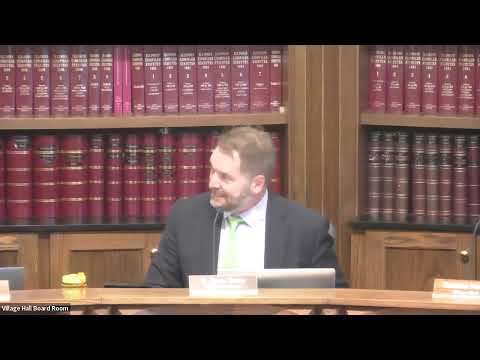
Lake Bluff trustees spent the June 23 Committee of the Whole meeting debating whether to adopt a formal display policy for flags and signs on village property and whether to change special-event permit rules, including who may sponsor events and how long displays may remain on the Village Green. No final policy was adopted; trustees asked staff to develop options and return to a future workshop.
The discussion opened after staff summarized two items in a memorandum: a proposed display policy to ‘‘capture what’s how the village is displaying messages and its government flags and government announcements,’’ and possible changes to the village’s special-event permitting program, including limits on event duration and which applicants are eligible, Drew, village staff, told trustees.
The proposal would formalize how the village treats government vs. private speech at public sites such as the gazebo and Village Green. ‘‘I will tell you from a staff’s perspective, it does make it easier if the village does adopt a display policy,’’ Drew said, noting the policy packet also contains language about holiday decorations and that the village previously used the permit process to allow a menorah for eight days.
Trustees split on how far to go. Some supported setting a short, explicit list of government flags — for example, federal, state, county and village flags — as a ‘‘vanilla’’ baseline while leaving the door open to future changes. Others urged patience given recent community disagreement and warned against appearing to close discussion after the board had previously agreed to study the issue further.
On special events, the board debated two recurring questions: whether the village should limit permits to applicants with a local connection (a resident sponsor, sponsoring organization, or named event manager) and whether to set a firm time limit on displays and events. Staff said it has been using an informal outer limit of 14 days for some recent requests but that past events have ranged from one-hour uses to multi-day programs.
Several trustees and staff expressed concern about the possibility of ‘‘outside actors’’ using the Green to stage disruptive or inflammatory displays and said a local sponsor on the permit could provide a community connection without creating legal liability for that sponsor. One motion of practical agreement among trustees was to require a local contact or sponsor be named on a permit while clarifying that the sponsor would not carry legal liability for the content of the display. That concept drew general support but was not adopted as a binding rule at the meeting.
Trustees discussed alternative time limits, including 7, 14 and 30 days or no fixed limit. Some said a short outer limit such as 14 days gives administrators discretion and mirrors practices in other communities; others preferred no set time limit so the village would not appear to restrict private speech unnecessarily. Staff noted that some comparable municipal public forums impose limits (one trustee cited 30 days used by nearby municipalities), and that leaving the Green entirely open carries risk of very long or continuous occupation.
Public commenters who helped organize recent displays on the gazebo urged the board not to conflate support for a particular symbol with the government-speech question. One resident who helped organize the gazebo display said the board members who voted against using the U.S. flagpole ‘‘actively, physically took a part in putting up that display’’ and asked the community to avoid labeling trustees’ motives. During public comment the resident recounted a family taking a photograph at the gazebo and said of the children in the photo, ‘‘On the count of 3 kids, yell, love wins. That’s what this is about.’’
No formal changes to the village’s code or permit rules were adopted. Trustees directed staff to return with comparative examples from nearby communities, clarified language options, and potential administrative procedures for sponsorship and duration. One trustee said he and staff would ‘‘go back and kick around some stuff and bring it back to a future workshop.’’
The Committee of the Whole unanimously approved routine minutes from the June 9 meeting earlier in the agenda; it also adjourned the meeting by voice vote. The board left the substantive display and special-event questions open for further study rather than adopting an immediate policy.
Next steps: staff will prepare options and examples from other municipalities and return the topic to a future workshop for more granular drafting and deliberation.