Get Full Government Meeting Transcripts, Videos, & Alerts Forever!
Get email alerts on the Rail Rights Of Way topic
No spam. Unsubscribe anytime.
Commission accepts CSX five‑year vegetation management maps; herbicide application limited near wetlands
Summary
CSX’s five-year vegetation management plan was reviewed and accepted as submitted. The railroad applies herbicide to rights-of-way, generally once per year, and the commission reviewed no‑spray zones and GPS‑based mapping for areas within 10 feet of the track near wetlands and waterbodies.
The Springfield Conservation Commission accepted CSX Transportation’s five‑year vegetation management maps after a public presentation and questions about no‑spray zones near wetlands.
Steve Herzog of VHB, representing CSX, told the commission the company files the RDA every five years and that herbicide applications to the rail right‑of‑way generally occur once per year. “CSX applies herbicides once per year,” Herzog said, adding that a handheld GPS with submeter accuracy now guides mapping of no‑spray areas.
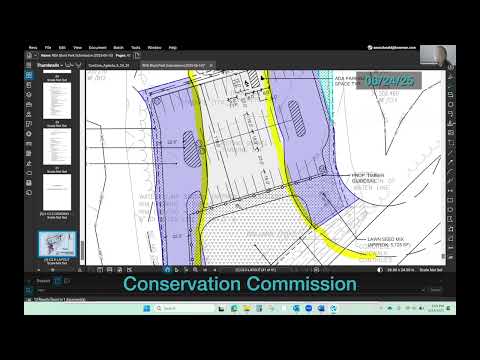
Herzog showed maps of the CSX line through Springfield and pointed out locations where wetlands, culverts and water bodies lie within 10 feet of the ballast. He said yellow‑marked zones on the maps indicate sides of the track where herbicide application is prohibited; where wetlands or open water lie within 10 feet of the ballast, those areas are marked as no‑spray. Herzog said herbicides used on the right‑of‑way are those approved by the Massachusetts Department of Environmental Protection for use in sensitive areas and that the railroad uses the same herbicide formulations unless a yellow no‑spray zone prohibits application.
Commissioners asked whether no‑spray zones had changed since the prior RDA; Herzog said the zones are generally unchanged, with only minor mapping variances due to improved GPS accuracy. The commission closed the public hearing and voted to accept the plan “as is,” with roll‑call approval.
Because herbicide selection and approval are governed by state agencies, commissioners noted that their local role focuses on reviewing and approving maps that identify no‑spray areas and buffer protections rather than selecting chemicals or application schedules.