Get Full Government Meeting Transcripts, Videos, & Alerts Forever!
Get email alerts on the Parks And Wetlands topic
No spam. Unsubscribe anytime.
Conservation commission finds Blunt Park improvements subject to jurisdiction but waives formal filing with inspection condition
Summary
The Springfield Conservation Commission found proposed improvements at Blunt Park are within the commission’s jurisdiction but approved the project without requiring a formal filing so long as the city inspects erosion controls before work begins.
The Springfield Conservation Commission found proposed improvements at Blunt Park are within the commission’s jurisdiction but approved the project without requiring a formal filing so long as the city inspects erosion controls before work begins.
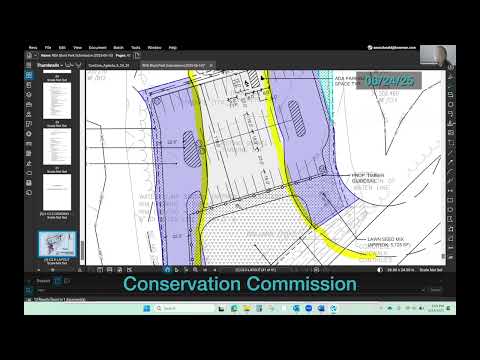
City consultant Stephanie McDonald, speaking for the city of Springfield and Bowman, said the project would improve an existing compacted gravel parking lot, renovate a stone-dust track and ball fields, and add a bioretention basin to improve water quality. “I’m here on behalf of the city of Springfield. My name is Stephanie McDonald, a part of Bowman,” McDonald said while presenting site plans and buffer maps.
The commission’s action follows McDonald’s presentation showing the project footprint remains largely within the existing disturbed areas. She told the commission the area inside the 100-foot wetland buffer totals about 31,000 square feet and that roughly 1,400 square feet lie inside the city’s 50-foot no-disturb zone; she said the work in those zones is limited to previously developed surfaces including the gravel lot and a narrow portion of the running track. The proposal calls for silt fence and straw wattles around wetland edges, preserving the existing grading to maintain sheet flow toward the wetlands and placing a bioretention basin where parking runoff can receive treatment before reaching wetland areas.
Commissioners pressed for details on sediment controls, grading and winter maintenance after McDonald said the existing subbase would be reused and pavement layered on top. One commissioner noted public works historically stored snow near the site and asked whether runoff from snowmelt would now flow untreated; McDonald said the basin and proposed operation-and-maintenance plan would allow cleaning and sediment removal after winter melt, providing more treatment than current conditions.
After public discussion and a vote, the commission adopted a motion that the activity is “applicable” to the commission’s jurisdiction but does not require a formal filing provided commission staff inspect erosion controls (including straw wattles and silt fence) prior to and during work. The motion passed on a roll call with all voting commissioners recorded as yes.
The commission did not adopt additional special conditions at the meeting but said staff would verify the installed sediment controls and that the city will include basin maintenance in its O&M program. The item will return to the commission only if on-site inspections identify issues or if the proponent requests further permitting steps.