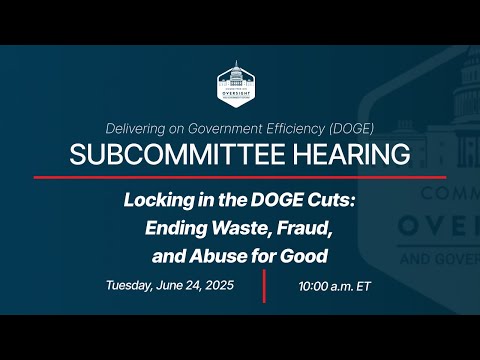
House subcommittee debates making ‘DOGE’ cuts permanent as Democrats warn of disrupted services
Get AI-powered insights, summaries, and transcripts
SubscribeSummary
The House Oversight and Reform Committee’s subcommittee on delivering on government efficiency opened a contentious hearing on the Trump administration’s Department of Government Efficiency, known in the hearing as “DOGE,” with Republicans urging Congress to lock in agency cuts and rescissions and Democrats warning of immediate harm to veterans, seniors and public-health programs.
The hearing centered on the administration’s $9,000,000,000 rescission request, the House-passed Rescission Act of 2025 (H.R. 4) and claims from administration allies that DOGE has identified roughly $180,000,000,000 in savings. Chairwoman Green said the initiative is meant to “give the American people a smaller, less bureaucratic government,” while Ranking Member Rep. Stansbury and other Democrats said the cuts have caused service disruptions and human harm.
Why it matters: Committee members and witnesses tied DOGE proposals to major programmatic impacts—reduced staffing at the Social Security Administration and Department of Veterans Affairs, interrupted clinical trials and rescinded grants at agencies including NIH and NSF—while also framing the debate as one over Congress’s use of appropriations and rescissions to make administrative changes permanent.
Republican members and several witnesses argued the federal budget is on an unsustainable trajectory and that Congress should act to codify DOGE savings. Witness Matthew Dickerson, director of budget policy at the Economic Policy Innovation Center, told the panel that “the fiscal state of our nation is deteriorating” and urged use of appropriations, rescissions and reconciliation to lock in savings. Witnesses David Burton and Dan Lipps likewise recommended using congressional legislation to make efficiencies permanent and to strengthen cross-agency payment verification tools such as Treasury’s “Do Not Pay” system.
Democrats and other witnesses urged caution and said the administration’s actions have produced serious service problems. Emily DeVito, senior advisor for economic policy at Groundwork Collaborative, said DOGE “has failed” and argued that cuts and staff departures have “disrupted access to critical monthly benefits” and degraded services at the Department of Veterans Affairs and Social Security. Democrats cited specific harms reported to the committee, ranging from difficulty accessing benefit payments to interrupted clinical trials for veterans.
Committee members on both sides repeatedly referenced administrative figures offered by the administration: a suggested downsizing by attrition of roughly 100,000 federal positions and larger estimates described in witnesses’ testimony (e.g., a 12% workforce reduction equating in administration statements to 252,000 positions). Members and witnesses also debated the size of claimed savings—witnesses supporting DOGE cited agency tallies posted to a public dashboard; critics said those figures are unreliable and that net savings may be far smaller after costs of rehiring and disrupted services are counted.
Members also aired examples of grant funding that DOGE flagged for rescission or termination. During questioning, the chair cited individual awards the administration identified as targets, including a reported $620,000 HHS grant for a teen-prevention program and several smaller NIH and NSF awards; Democratic members and witnesses pushed back that many of the grants fund clinical research and services that, they said, protect public health and support vulnerable populations.
The hearing included a committee-level dispute over oversight of DOGE’s origins. Representative Crockett proposed that the committee subpoena Elon Musk, the private-sector figure who previously advised the effort; Representative Burchard moved to table that subpoena motion and the committee tabled it after a recorded voice vote (the clerk reported 4 no votes). The chair announced that members retain five legislative days to submit additional materials and questions for the witnesses.
What was not decided: The hearing produced no new legislation. Republicans said H.R. 4 and future rescissions and appropriations will be the means to make DOGE changes permanent; Democrats said Congress should not codify actions that, they argued, have produced documented service disruptions and human costs.
Looking ahead: Members on both sides said they will pursue follow-up oversight—Republicans to press for statutory codification of DOGE changes and additional rescissions; Democrats to investigate service impacts and to call for restoring staff and funding in agencies they say were harmed. The committee set no calendar for additional votes on the substantive rescissions discussed at the hearing.
Votes at a glance: The committee voted to table the motion to subpoena Elon Musk; the clerk reported the tally as “the nos are 4” and that the motion to table carried. The committee did not take other recorded roll-call votes on rescissions or bills during this session.