Get Full Government Meeting Transcripts, Videos, & Alerts Forever!
Get email alerts on the Land Use topic
No spam. Unsubscribe anytime.
Planning board denies Twin Lakes PUD amendment to add townhomes on 26‑acre parcel
Summary
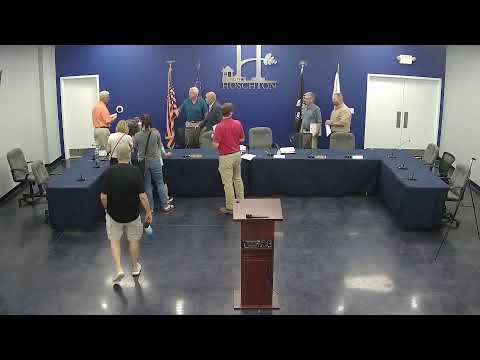
Hoschton City Planning and Zoning Board denied a proposed amendment to the Twin Lakes PUD that would convert a 26‑acre commercial parcel to residential townhomes after public concerns about traffic, schools and emergency services and questions about market analysis and conditions.
The Hoschton City Planning and Zoning Board on a voice vote denied an application to amend the Twin Lakes planned unit development (PUD) to allow roughly 204 townhomes on a 24–26 acre parcel that had been reserved for commercial use.
Residents who spoke during the public-comment period urged caution, saying the change would increase traffic and place added demands on schools and emergency services. The applicant team and developer representatives said the parcel had been rezoned years ago with the expectation that rooftops would support retail, but they had not completed a contemporary market study or a traffic study specific to this amendment.
Why it matters: The parcel sits in the Twin Lakes master plan, a large mixed‑use area anchored by a Publix and a Kroger across Highway 53. Changing the parcel from commercial to residential would shift where retail demand is met and could affect traffic patterns, school bus routes and county emergency resources.
Public speakers voiced concern about congestion during peak hours and the cumulative impacts of ongoing development. Resident Jerry Esposito said, “Just 1 other concern I have is really the traffic… If it's residential, there's still gonna be traffic.” Alice Lee Tanner, a 29‑year Hoschton resident, noted the city’s recent growth and argued the city should prioritize jobs and commercial development: “We have…increased our population by 400%…we're considering rezoning land that could be used to build businesses, that generate jobs.” Howard Borsa urged planners to consider existing residential approvals, saying the city had “approved enough residential buildings to handle the expected need through 2029.”
Applicant representatives said the parcel’s original PUD contemplated a mix of rooftops and up to 300,000–400,000 square feet of retail. Bruce Williams, identifying himself as representing the Scott Hudgens Family Foundation and the Hudgens commercial interests, said it took years to secure Publix and that Kroger located across the street for competitive reasons. Ben Johnson, a representative of Brookfield Coulter Land Partners, explained the company structure and said Colterland is the horizontal developer while Colter Homes is a homebuilder brand. He said the firms had spoken with potential commercial tenants but had not completed a formal market study for the parcel.
Board members pressed the applicant on specifics. Staff and the applicant confirmed the packet did not include a traffic assessment required for developments over 10 acres; the applicant said a traffic study could be added as a condition. The applicant said the site plan shows a linear park about 75 feet wide adjacent to the street as the primary public green space for the proposed townhomes; individual unit lots were described as roughly 24 by 100 feet. The applicant estimated an initial sales price near $350,000 as a starting sales price, noting options and upgrades could push final prices higher.
On infrastructure and timing, the applicant sketched a build schedule assuming prompt approvals: land‑disturbance and permit submissions in the months after approval, infrastructure work through spring 2026, first units delivered in late 2026 and later phases completing in 2027. The applicant said they had not contacted the school superintendent or emergency services offices as part of this application; board members and residents later described conversations with local school and public‑safety officials estimating several additional school buses and added fire/police resources would be needed as growth continues.
Board member Chris Harden proposed a set of conditions intended to preserve commercial opportunity and increase open space: limit the number of townhomes to about 100, dedicate roughly 20% of the parcel to green space, and phase residential build‑out so commercial parcels develop concurrently. After discussion, a motion was made and seconded to deny the amendment as proposed; the chair called for a voice vote and the motion to deny carried. The meeting record shows the denial was approved by voice vote; the transcript does not record a roll‑call tally or named votes.
A related variance, application VDash25‑01 to reduce on‑site parking, was withdrawn by the applicant earlier in the meeting and will not proceed to a vote.
What’s next: Board staff said the applicant could return with a revised application addressing conditions and additional studies or choose to pursue the amendment elsewhere. Developers and staff indicated that larger changes to the site plan could require coordination with the property owner and possible tabling to a future meeting for further negotiation.