Get Full Government Meeting Transcripts, Videos, & Alerts Forever!
Get email alerts on the Local Taxation Grocery topic
No spam. Unsubscribe anytime.
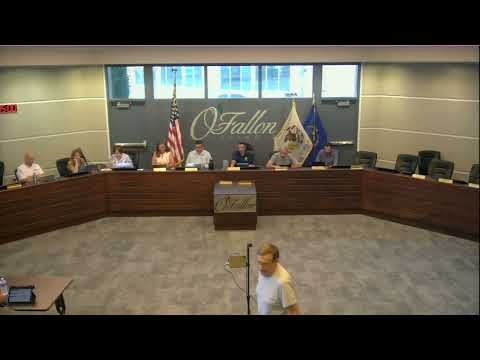
O'Fallon council retains 1% grocery sales tax; Roach votes no
Summary
The O'Fallon council voted to retain a 1% grocery sales tax that the state will repeal January 1, 2026. Councilmember Todd Roach dissented; supporters said the revenue funds public safety and local projects.
O'Fallon — The City Council voted to retain a 1% grocery sales tax that the state is repealing effective Jan. 1, 2026, preserving roughly $1.2 million a year for the city’s general fund.
Councilmember Jessica Lott and other supporters said the tax funds public safety and local projects; Councilmember Todd Roach said he opposed adding the tax burden on necessities. The ordinance passed on a 4-1 roll call vote.
The ordinance would continue the current 1% grocery tax under the city’s home-rule authority after the state repeal takes effect. Sandy, city finance staff, told the committee the state’s public act removes the statewide grocery tax but allows local governments to retain a local grocery tax; she said the city’s estimate of the annual revenue from retaining the tax is about $1,200,000. "This is not a new tax," Sandy said, noting residents would pay the same amount on a grocery bill if the city retains the tax.
Supporters said the revenue is key to the city’s general fund. "We will collect about $10,000,000 in sales tax in the general fund, and the police department alone costs $9,000,000," Councilmember Jessica Lott said, adding she supported rolling over the existing grocery tax to avoid cuts. Opponents argued the levy disproportionately affects low-income households. "It's hurting those families that are most in need," Councilmember Todd Roach said. "I would be adamantly opposed."
Sandy added that residents who receive SNAP or other assistance programs are already exempt from the grocery tax. She also said surrounding municipalities — including Belleville, Fairview Heights, Shiloh, Collinsville, Edwardsville and Lebanon — have elected to retain the tax. The city must submit ordinances to the Illinois Department of Revenue by Oct. 1 for a smooth transition by Jan. 1, Sandy said.
On a roll call after a motion, the votes were: Nathan Parchment, yes; Jim Campbell, yes; Todd Roach, no; Jessica Lott, yes; Jim Blackburn, yes. The motion passed and the ordinance will move forward for final adoption and filing with the Department of Revenue.
The council and staff discussed alternatives to the grocery tax, including raising the general sales tax in quarter-percent increments and other revenue options such as a streaming (amusement) tax. Sandy said prior reviews found other revenue sources would not make up the roughly $1.2 million shortfall the grocery tax covers. Councilmembers noted the filing deadline and the potential annual revenue loss if the city did not retain the tax.
The city’s estimate and related figures were presented as estimates; Sandy said the state does not separately report grocery tax receipts and the $1.2 million figure is an approximation based on local store sales data.