
Jackson County panel hears Restart briefing on housing-first approach; RFQ planned for county land
Get AI-powered insights, summaries, and transcripts
Subscribe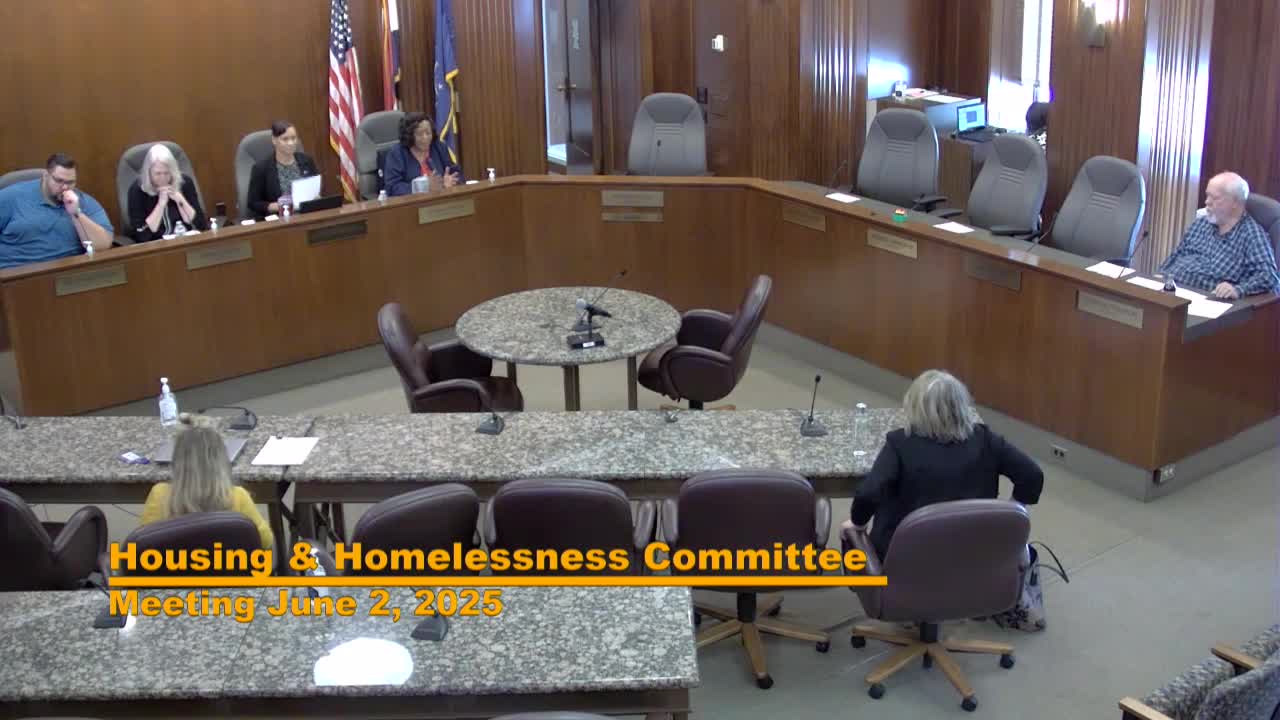
Summary
The Jackson County Housing and Homelessness Committee heard a presentation from Restart on regional homelessness data and housing-first strategies and signaled plans to issue an RFQ to develop county-owned land for affordable housing; staff have completed floodplain mapping and phase I testing on the site.
The Jackson County Housing and Homelessness Committee on Tuesday heard a presentation from Restart about homelessness trends in the Kansas City metropolitan area and next steps to develop affordable housing on county-owned land.
The committee chair said the county was accepted into the National Association of Counties Sprint program and that the Sprint helped identify county-owned parkland across from the stadiums between Raytown Road and Manchester as a potential development site; the chair said flood‑plain mapping and Phase I environmental testing on the property are complete and that the county plans to issue a request for qualifications to select development partners.
"Housing is the foundation to everything in our community," Restart guest speaker Miss Boyer told the committee. Boyer summarized regional homelessness figures used in federal reporting and the organization’s view of effective responses. "When you look at all the things under neighborhood and built environment, without those things, we don't get to the other things," she said.
Nut graf: Restart asked the committee to treat housing production and targeted local supports as the core of any strategy to reduce homelessness, arguing the county should combine zoning changes, land allocation and local rental-assistance resources with case management and landlord partnerships to reduce first‑time homelessness and chronic unsheltered homelessness.
Boyer reviewed the local point‑in‑time count the committee uses for federal funding decisions: the 2024 count recorded just over 2,200 people in the metro area on a single night, including about 876 people living unsheltered and roughly 329 people experiencing homelessness for the first time. She said the count is an undercount of total need and that HUD uses the annual January count to allocate Continuum of Care funds; Restart-represented projects currently receive about $15,000,000 in CoC funding, she said.
Boyer described major drivers behind rising homelessness: sharp rent increases and low vacancy rates since the COVID‑19 pandemic, gaps between wages and living costs, and the structure of HUD fair‑market calculations that average widely divergent counties and jurisdictions. She told the committee that average individual income within Kansas City, Missouri, is about $40,000 and cited living‑wage and minimum‑wage figures discussed in the presentation (living wage cited at $20.87/hour; minimum wage at $13.75/hour).
She urged the committee to pursue a housing‑first strategy backed by prevention and services. "Sometimes it's just getting a case manager in that household to act," Boyer said, and she recommended combining rental assistance with case management rather than delivering short‑term cash without services.
Committee members asked technical and program questions. One member clarified HUD reporting: communities must conduct an annual point‑in‑time count every January; a voluntary summer count does not affect HUD funding but can inform local advocacy and fundraising. The chair confirmed the identified development site is county parkland and that county zoning staff will be engaged as the RFQ process proceeds.
Committee members also discussed eviction prevention and landlord engagement. Boyer said local eviction prevention needs a pool of flexible funds, legal services, and stronger partnerships with landlords and property managers to house people without subsidy when possible; she said Restart places about two‑thirds of clients into permanent housing without ongoing subsidy, citing landlord relationships as a major factor.
Committee members expressed concern about federal funding uncertainty and potential federal policy changes that could reduce benefits on which many households rely. "There are so many people who are piecing supports together — if the pieces fall apart, so does their housing," Boyer said, urging local preparations for possible reductions in federal supports.
The committee did not take formal votes during the meeting. Next steps identified on the record included issuing an RFQ for the county‑owned site and coordinating zoning, floodplain, and environmental information with county staff prior to any solicitation.
Ending: Committee members thanked Restart for the briefing and encouraged continued coordination on Sprint program deliverables, local prevention strategies and landlord engagement as the county prepares the RFQ and next steps for site development.