Get Full Government Meeting Transcripts, Videos, & Alerts Forever!
Get email alerts on the Charter Review topic
No spam. Unsubscribe anytime.
Barnstable County charter review committee hears push for major structural change and narrower regional focus
Summary
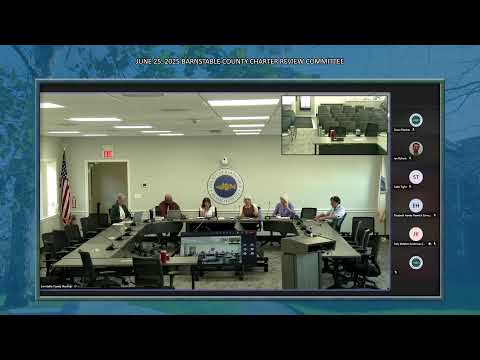
At a June 25, 2025 meeting, the Barnstable County Charter Review Committee heard testimony both for modest edits and for sweeping changes to county government structure, with witnesses arguing the county should focus on a few regional services such as dredging and water-quality programs.
The Barnstable County Charter Review Committee on June 25, 2025 heard conflicting views on whether the county charter should be tweaked line-by-line or overhauled to change how local regional government is structured.
The committee opened its hybrid meeting with testimony from regional officials and stakeholders urging either a minimalist approach — fixing unclear charter language — or a broader redesign that would remove duplicated functions between the assembly of delegates and the county commissioners.
Commissioner Ronald Bergstrom, a regional commissioner who addressed the panel, said the county provides services towns cannot, and urged caution about sweeping change: "I personally think we're doing a lot of good, and I think that the organization we have now is working pretty well," he said, describing a preference for a limited, careful review of inconsistent or vague charter language.
Andrew Gottlieb, executive director of the Association to Preserve Cape Cod, told the committee the county should narrow its mission to tasks that are clearly regional and hard for towns to replicate, such as beach-sampling and water‑quality programs, and warned that the current dual executive–legislative structure causes recurring conflicts. After outlining that view he summed up his recommendation tersely: "I would go big."
Paul (chief executive officer, Cape Cod Chamber of Commerce) urged the committee to focus the county on regional service delivery and questioned whether the internal review process will produce structural change. He recommended changing how the charter review is conducted so the process is more likely to produce substantive results.
Committee members and guests discussed specific operational issues as examples of where a clarified or restructured county might direct resources: dredging programs, a regional Aqua Fund for septic and sewer connections, and technical assistance for homeowners. Witnesses repeatedly cited the county budget as context for discussion: speakers noted an annual county budget of about $20,000,000 and described health‑insurance exposure for elected officials and benefits as a recurring fiscal question (witnesses estimated roughly $500,000 in benefit exposure related to elected officials).
Committee members said they will continue to review the charter section-by-section, starting with the assembly article, and to gather legal guidance about what changes can be recommended by the committee itself and which changes require a separate elected charter commission or action by the legislature. Staff advised the panel that some structural changes historically have required legislative approval and that earlier review cycles (including reports from 1989, 2012 and others) addressed many of the same permutations.
The committee did take a small number of procedural actions during the meeting: it authorized the clerk and assistant clerk to work with the chair and counsel to draft updated grammar and remove outdated references in the charter text; and it scheduled the next committee meeting for July 9, 2025, at 4 p.m. (both motions were approved by roll call of members present). No final structural recommendations were made at the June 25 meeting.
Why it matters: The committee’s decisions will shape whether Barnstable County remains a general-purpose county performing multiple programs for the region or moves to a narrower, professionalized regional authority. That choice affects how limited county resources are allocated among services such as dredging, water quality, housing and childcare and who sets priorities: an elected assembly of town delegates, an expanded or different elected body, or a professional manager with clearer executive authority.
The committee will continue its item-by-item review in future meetings and invited more stakeholders and legal counsel to return at subsequent sessions.