Get Full Government Meeting Transcripts, Videos, & Alerts Forever!
Get email alerts on the Enrollment And Facilities topic
No spam. Unsubscribe anytime.
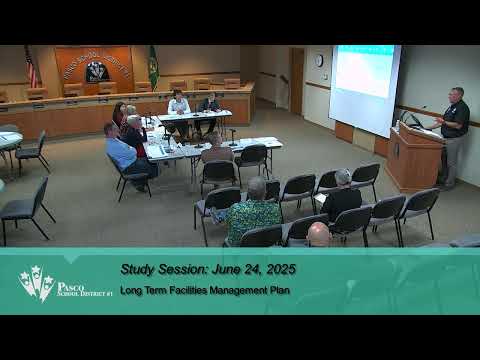
Pasco School District study session: economists project modest K–12 growth; community survey favors replacing aging schools
Summary
Eastern Washington University economists presented 10-year enrollment projections and district staff summarized a community facilities survey during a Pasco School District study session, reporting a likely net increase of roughly 400 to 600 students districtwide over the next decade and strong public interest in replacing aging school buildings.
Eastern Washington University economists presented 10-year enrollment projections and district staff summarized a community facilities survey during a Pasco School District study session, reporting a likely net increase of roughly 400 to 600 students districtwide over the next decade and strong public interest in replacing aging school buildings.
The board heard the projections from Dr. Kelly Cullen and Dr. Patrick Jones of Eastern Washington University and a summary of survey results from district staff member Jake Sickle. Dr. Cullen said the team ran multiple forecasting methods and presented ranges rather than single-point estimates: "at a low end, your enrollments could be ... 8,800, almost 8,900. But at a high end, it could be as high as 9,200," referring to elementary-level totals in 2034–35. The presenters also summarized their best-fit models and sensitivity checks, and described an average outcome that would add hundreds of elementary students over the decade.
Why it matters: the district is developing a long-term facilities management plan tied to a series of bond packages. The survey of roughly 500 respondents showed the top community priorities were replacing old and outdated buildings and improving safety and security; respondents were divided between a faster, larger-build scenario (scenario B) and a slower, smaller scenario (scenario A), with cost and tax impact repeatedly raised by commenters.
Projections and other data presented - Dr. Jones and Dr. Cullen noted that Washington State Office of Financial Management (OFM) forecasts a county population increase of about 18,100 over the coming decade and an increase of roughly 990 people aged 5–19; the consultants said that, after adjusting for district boundaries, private-school attendance and other factors, their district-level projections were lower than the OFM age-group total. - Presenters gave a districtwide projected growth range of about 400–600 new students over 10 years; Dr. Sickle summarized that as roughly 40–65 new students per year on average. - For elementary grades the consultants presented a midrange estimate equivalent to an increase of roughly 440 students over 10 years and graph ranges with a lower bound near 8,800 and an upper bound near 9,200 (2034–35). Presenters described middle-school forecasts as modest growth (low-to-high estimates cited in the 4,600–4,788 range) and said high-school projections were more uncertain, with models showing both slight declines and modest increases depending on the method used. - The consultants also examined fertility trends (Washington Department of Health data), county net migration, and local building-permit activity (single-family permits declining since 2022 while multifamily permits rose). They reported that 82% of current elementary students live in single-family homes, based on the district dataset for 2024–25.
Community survey: priorities and trade-offs District staff condensed about 41 pages of survey responses into a one-page summary for board review. The summary showed: 187 respondents ranked "replace old and outdated buildings" first; improving safety and security was the second-most chosen top priority. When asked to choose between two bond scenarios, 269 respondents preferred Scenario B (faster timeline, more projects) and 127 chose Scenario A (slower timeline, fewer projects); roughly 78 said they needed more information.
During a table exercise, board members reported recurring themes in the comments: (1) urgency to address unsafe or aging buildings, (2) concern about tax burden and cost increases, (3) differing views about the appropriate speed and scale for projects, and (4) requests for more information. Several commenters framed material-cost inflation as a reason to build sooner; others said household tax impacts favored a slower approach.
Next steps and board direction Staff emphasized that no final decisions were made at the study session. The long-term facilities management plan under development is structured as four bond packages spaced roughly four years apart; the board will later review and may approve that plan (staff said approval was expected in the fall, with staff returning to the board on August 12 to continue the discussion). Staff also said they would share the consultants' supplemental slides and offered to meet individually with board members to review the dataset and the survey comments.
Quotes "We came up with roughly 405 in the disaggregated way ... the 600 odd. So I think that's a pretty good range of 400 to 600 new students over a 10 year period," Dr. Patrick Jones said when summarizing the team's range of district-level estimates. "We think that at a low end, your enrollments could be ... 8,800, almost 8,900. But at a high end, it could be as high as 9,200," Dr. Kelly Cullen said about elementary-grade projections.
Ending Board members and staff said they would use the projections and the community input to refine the facilities plan and bring a recommended schedule and financing approach back for discussion and potential approval later this year. No formal motions or votes occurred during the study session.