Get Full Government Meeting Transcripts, Videos, & Alerts Forever!
Get email alerts on the State Legislation topic
No spam. Unsubscribe anytime.
Sumner staff outline which 2025 state bills could reshape local funding, land use and public works
Summary
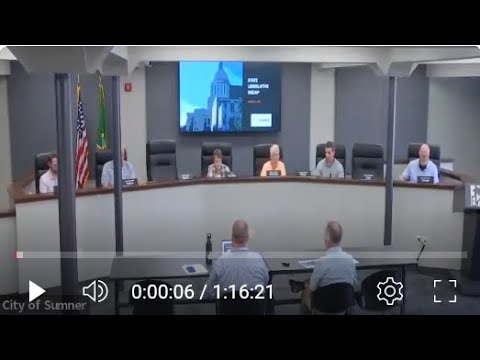
At a June 23 Sumner City Council study session, communications director Carmen Palmer and city lobbyist Bill Clark gave a detailed briefing on the 2025 Washington legislative session and the bills that passed, failed or remain active that could affect Sumner’s operations, funding and land-use authority.
At a June 23 Sumner City Council study session, communications director Carmen Palmer and city lobbyist Bill Clark gave a detailed briefing on the 2025 Washington legislative session and the bills that passed, failed or remain active that could affect Sumner’s operations, funding and land-use authority.
The session mattered because it touched on long-running city priorities — funding for public works projects, new regulatory requirements for housing and development, and public-safety funding — and left a mix of permanent changes and proposals likely to return in 2026.
Palmer and Clark told the council the category that hit Sumner hardest this year was “reasonable funding and support for cities.” Palmer said the legislature produced a “waterfall” of bills and urged vigilance as incremental changes can “creep” back in future sessions. Clark warned of uncertainty in environmental rules and expensive long-term liabilities, particularly around PFAS contamination at water and wastewater systems. “Some jurisdictions in Washington state have spent $12,000,000, $20,000,000 on PFOS treatment only to find out they may not have built that treatment plan to what the ultimate regulatory standard will be,” Clark said, calling PFAS regulation a multibillion-dollar national issue.
Key items staff highlighted: - Funding: The Public Works Trust Fund survived the session but staff said the legislature’s short-term practice of using cash from the fund for operating needs and backfilling with state debt is worrying because it raises long-term costs for cities and utility ratepayers. Clark explained that state backfill through debt increases borrowing costs compared with the fund’s usual low-rate loans. - PFAS and water/wastewater regulation: Clark and staff said state standards for PFAS remain in flux, creating uncertainty for local treatment projects and capital planning. - Land use and housing: Several bills affecting housing and development reached the governor or were amended. Staff said a transit-oriented development bill (identified in the briefing as 1491) was amended to limit the radius around stations to a quarter-mile rather than a half-mile — an amendment the presenters credited to local advocacy. Other passed items include updates to paid family medical leave, changes to building codes and a new requirement that cities permit childcare centers in most zones. Staff said a state review process for housing elements was made voluntary for most cities but mandatory for a limited number of underperforming cities each year. - Parking and permitting: A parking-related bill was amended so it applies only to cities with populations above 30,000; other bills would limit local parking regulation or adjust permitting timelines. Staff cautioned many bills were detailed and could return in future sessions with narrower thresholds. - Public-safety funding and criminal-justice developments: The 2025 package included competitive grants for recruiting and retaining officers, but staff stressed the program is one-time, competitive and requires cities to adopt a local sales-tax increase first. The presenters also noted recent Washington Supreme Court indigent-defense standards and other criminal-justice proposals that could increase local costs or change local procedure.
Palmer and Clark said many bills that did not pass in 2025 are likely to return in 2026 — examples they mentioned included proposals on streamlining permitting, mobile dwelling units, and changes to juvenile placement and sentencing enhancements. Palmer said the council’s legislative agenda for 2026 will focus on the bills that moved this year and that staff will continue monitoring.
No formal motions or votes on state policy were made at the study session. Staff asked the council for permission to continue legislative monitoring and to begin drafting the 2026 agenda; the council did not take formal action at the meeting.
Staff asked the public to watch for follow-ups if they want to weigh in. Palmer thanked the city’s legislators for responsiveness during the session and reminded the council that the 2026 short session will focus on bills already introduced in 2025. Clark and Palmer urged ongoing local engagement because small, technical changes in future sessions could meaningfully change how the laws apply to Sumner.
Looking ahead, staff said they will bring specific policy recommendations to the council as proposals re-emerge in Olympia and that municipal officials will continue to prioritize clarity on funding sources and the limits of local authority.