Get Full Government Meeting Transcripts, Videos, & Alerts Forever!
Get email alerts on the Archaeology South Texas topic
No spam. Unsubscribe anytime.
Nick Morales outlines South Texas archaeology and collecting rules at Mission Historical Museum lecture
Summary
At a Mission Historical Museum lecture, retired University of Texas Pan American staffer Nick Morales reviewed lithic materials, tool types and field documentation methods, and cautioned that collecting on public lands is illegal while collecting on private land with permission is allowed.
Nick Morales, retired University of Texas Pan American computing staff and longtime amateur archaeologist, gave a roughly 45-minute public lecture at the Mission Historical Museum on the archaeology of South Texas, the stone materials ancient peoples used for tools, and best practices for documenting finds.
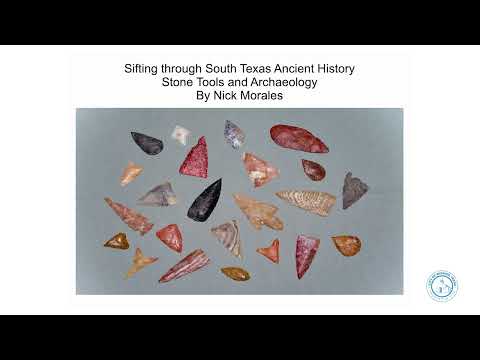
Morales told the audience the coastal sediments where some artifacts are found were deposited by the Rio Grande and described local rock types such as chert, petrified wood and rhyolite that ancient toolmakers used. He also discussed differences among projectile points, atlatl (spear-thrower) darts and smaller arrowheads, and demonstrated how to document finds in the field using GPS and simple logging methods.
The lecture provided context for why particular rocks were favored for tools, noting that hardness and the ability to be flaked made materials such as flint, chert and petrified wood useful. Morales described a regional deposit he called “El Sauss chert” formed by volcanic ash that was quarried historically for tool making. He said projectile points remain abundant across South Texas and Northern Mexico, and that some tool types can be used to infer age ranges when compared with known examples such as Clovis points.
Morales emphasized documentation and preservation. “If you pick up something or anytime you dig up something, you disturb it, and then its history cannot be replaced,” he said, urging attendees to record location, date and type of each item. He described his own method: “I use a GPS watch that gives me an exact location, and then I use a program that shows every step that I took… and then those artifacts I place in a chronological order.”
He also addressed the legal limits on collecting: “If you're out on somebody's property, private property, and you have permission to be on that property, you can pick up whatever you want. It's totally legal. But you cannot pick up items in state, local, federal land. That is against the law,” Morales said.
The presentation included artifacts on display, examples of projectile points, scrapers, hand axes, grinding stones (manos and metates) and rarer items such as gorgets. Morales explained functional differences—large points matching atlatl darts, smaller points used on short bows and arrows—and cautioned against assuming every napped stone is an arrowhead: “The proper terminology is it's a projectile point, because you don't know what it is until you come and done identify it.”
Museum staff opened with housekeeping information about the museum’s hours and lecture series. “Our hours are every Tuesday to Friday from 1 to 4PM, and we're open every second Saturday of the month,” the staff member said, and invited attendees to return for the monthly lecture series.
After the prepared remarks Morales invited questions and noted he offers a geologic-history tour from McAllen to Falcon Lake; he said the tours do not focus on point-hunting but that artifacts are commonly found along the route.
The lecture combined technical discussion of lithic materials and tool forms with practical advice on documentation and legal limits on collecting. Attendees were invited to view the displayed artifacts and ask follow-up questions at the end of the program.