Get Full Government Meeting Transcripts, Videos, & Alerts Forever!
Get email alerts on the Bracero Program Women topic
No spam. Unsubscribe anytime.
Researcher recounts bracero-era hardships and the shifting role of women in Mexico
Summary
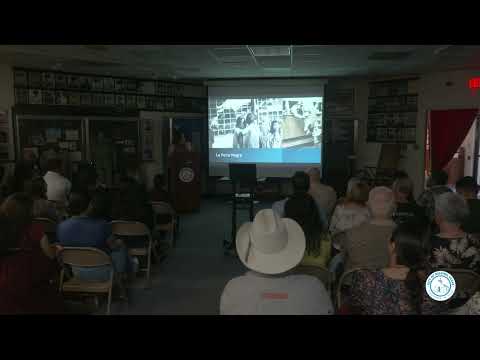
At a Mission Historical Museum lecture, Dr. Abila summarized oral histories from wives and widows of bracero workers, describing long separations, economic hardships, deductions from pay, living conditions in U.S. labor camps, and social consequences for women left to provide for families.
Dr. Abila, a lecturer introduced at a Mission Historical Museum event, described findings from oral-history interviews with women whose husbands worked under the U.S.-Mexico Bracero program, which she said began on 08/04/1942 and ended in 1964.
The lecture summarized how long labor contracts, low net pay after employer deductions, and housing provided by employers shaped women’s daily lives back in Mexico. “Most workers were grabbed by the arms to make sure that they had muscles,” Dr. Abila said, describing physical inspections at processing centers. She also recounted pay stubs that, after deductions, left some men with only “1¢” for a week and examples where farmers deducted costs for blankets, insurance and board from wages.
The program’s processing sequence, Dr. Abila said, started with health checks in Mexico City, then moved to border processing centers (referred to in the talk as El Centro) where men sometimes waited “for weeks, even months” before transport to U.S. work sites. She said men typically worked 16 to 18 hours a day and were sent to farms across 22 U.S. states (with Texas added in 1947).
Nut graf: The lecture focused on how extended male migration altered women’s economic and social roles. With husbands away for six to 18 months, women often became primary providers, worked in networks to share childcare and household tasks, or sought outside employment — outcomes that reshaped family life and, in some cases, led to increased divorce rates and new social norms.
Dr. Abila read multiple interview accounts illustrating the range of experiences. Some women formed rotating household networks: one interviewee, Natividad Llanas, described sleeping at a father-in-law’s home to protect her “virtue” and alternating daily chores among sisters so none were alone. Other interviewees described severe hardship: one woman, Modesta, had an eight-foot metal fence with a padlock and chain and would lock the interviewer inside the yard before allowing the interview — an illustration of long-term trauma and fear. Another woman, Rosa, described surviving as a de facto head of household while her husband drank and sent no money; she later said she felt she “was better off” when he was absent.
The lecture also addressed how women adapted economically: some worked as housekeepers at 20 pesos a week, sold food near processing centers, or traveled to nearby towns to buy supplies. Factory or maquiladora work later became common among daughters of bracero families. Dr. Abila noted that payment practices and record-keeping created complications: braceros’ withheld savings were sometimes misrecorded (for example, misspelled names) and led to legal claims decades later; she said some former workers received roughly $5,000 in settlements after suing for lost savings.
Dr. Abila emphasized that outcomes for women often depended on preexisting family relations. When husbands returned regularly and sent money, families reported better material conditions; where relationships were strained or absent, women assumed provider roles and sometimes faced social stigma. She said divorce cases rose during the 1950s, estimating “over 12,000” divorces in that decade related to women leaving the home to work or otherwise being absent.
The lecture closed by linking the program’s end in 1964 to later labor movements: Dr. Abila suggested that the end of the bracero program reduced readily available replacement labor for growers and helped empower farm-worker organizing, citing Cesar Chavez and the United Farm Workers movement as part of that historical sequence.
No formal decisions or policy actions were taken at the event; it was an informational lecture accompanied by audience questions about records, green cards and bracero savings accounts.
Ending: Dr. Abila invited further questions and pointed attendees to a documentary on the bracero program available with English and Spanish subtitles, then thanked the audience for attending the Mission Historical Museum lecture.