Get Full Government Meeting Transcripts, Videos, & Alerts Forever!
Get email alerts on the Local History Mission Family Citrus topic
No spam. Unsubscribe anytime.
Museum lecture traces Volts and Dauphin families and Mission's citrus boom
Summary
At an Ocean Historical Museum lecture, Matt Faucik recounted his family’s arrival in the Rio Grande Valley, how the La Lomita Mission influenced the city’s name and Charles Volts’ role in early grapefruit production, drawing on family papers, museum holdings and local archives.
Matt Faucik, a lecturer at the Ocean Historical Museum, used a museum presentation to trace his maternal family’s migration to the Rio Grande Valley and to describe early citrus farming that helped shape Mission’s economy.
“Thank you, Mission Museum. It's been, interesting, learning more about my mom's side of the family,” Faucik said as he opened the talk, which drew on family photographs, a 20th‑century memoir and holdings at local and university libraries.
Faucik told attendees that his great‑grandfather, Charles (born 1875), traveled from the Midwest to Texas in the early 1900s and that Charles and his wife Rose settled in the valley after arriving by steamer at Point Isabel. According to family accounts Faucik cited, the couple and other relatives settled near Brownsville and moved to Mission by about 1905. Faucik quoted a family memoir describing a difficult arrival at Point Isabel and a narrow‑gauge train that briefly stopped because it had run out of wood.
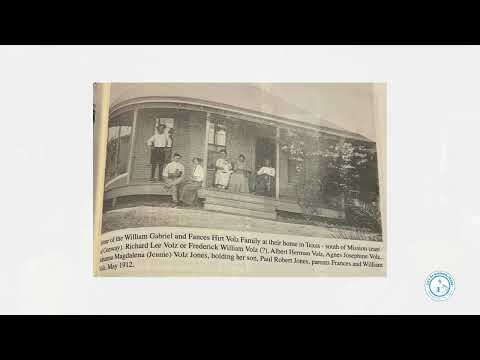
The lecture tied those family stories to the development of Mission and the valley’s early agriculture. Faucik said his grandmother Iris was the first Anglo child born in Mission in 1909 and that the family initially farmed with modest tools and household routines—kerosene lanterns, iceboxes and screen‑porch sleeping—until rural electrification reached some families in the 1930s.
Faucik recounted material from museum exhibits and archived business records showing that Charles worked in field crops and that early citrus cultivation became commercially significant in the 1920s and 1930s. He cited a museum display reporting that one onion/grapefruit field produced “410 crates” per acre at an average weight of about 95 pounds per crate, and that a harvest year “grossed almost $2,000” with a net profit of about $1,025 in the period described in those records. Faucik used those figures to illustrate how citrus could be a substantial source of income for valley growers in the first half of the 20th century.
On local place names, Faucik said family sources show Rose suggested naming the town after the nearby mission. “There was already a Mission City, Texas,” he said, explaining the family account that the community took the simpler name Mission in reference to the La Lomita Mission near the canal.
Faucik described how family members and later relatives—variously recorded in his materials as Dauphin, Dolphin or Dolfing—were involved in produce businesses, local marketing efforts and civic life. He said one relative, identified in his notes as Nick Dauphin (also spelled in his sources as Dolphin/Dolfing), was prominent in marketing and had operations north of Mission in the 1920s and ’30s. During audience questions Faucik directed listeners to museum exhibits and local printed sources for more detail on naming and road histories.
The presenter also described donating or consulting materials held at the Briscoe Library at the University of Texas and showed family artworks and photographs now in museum displays. He said a centennial‑era compilation assembled by a relative was distributed to state governor offices and later ended up in a rare‑book collection he encountered at a bookstore in Austin.
Faucik closed by noting he is continuing research and has drafted material for two book projects—one about his golf experiences and another on growing up in the valley—while showing examples of his art that have appeared in a local member gallery.
Charlotte Underwood, the museum assistant who introduced the program, opened the evening with housekeeping information about museum hours and the lecture series.
The lecture included a brief audience Q&A in which attendees asked about local road names and family connections; Faucik answered by pointing to archive materials and museum displays for follow‑up research.