Get Full Government Meeting Transcripts, Videos, & Alerts Forever!
Get email alerts on the Land Use Moratorium topic
No spam. Unsubscribe anytime.
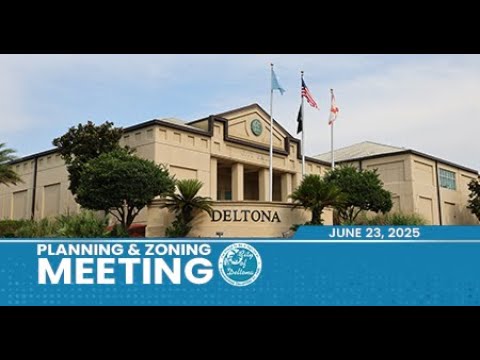
Deltona planning board recommends temporary moratorium on new residential development
Summary
The Deltona Planning and Zoning Board voted 4-3 to recommend the City Commission adopt Ordinance 29-2025, a temporary moratorium of up to nine months on new residential development applications, with specified exemptions and a contingency tied to pending state legislation.
The Deltona Planning and Zoning Board voted 4-3 to recommend that the City Commission adopt Ordinance 29-2025, a temporary moratorium of up to nine months on new residential development applications, rezonings and comprehensive-plan amendments.
Board members and staff said the pause is intended to give the city time to study infrastructure capacity, update land-development codes, and complete an impact-fee study before approving additional residential entitlements. "The moratorium targets new residential development applications including rezonings and plan amendments for residential uses," staff said during the presentation.
The ordinance text as presented would exempt commercial, industrial, office and school projects; projects on city- or Community Redevelopment Agency–owned land; applications with approved site plans or entitlements vested prior to June 30; and specific projects listed in Exhibit A. Staff told the board Exhibit A initially listed 24 ongoing projects totaling about 4,250 residential units; a revised Exhibit A later marked one Halifax option as contingent and showed an Option B of 575 multifamily units.
Board discussion focused on two themes: infrastructure and legal risk. Several members emphasized stormwater and community impacts. Member Trojnowski, who also identified herself as an HOA president, described recurring problems in her neighborhood and said, "It is continuously, every single day, dumping water down, down into Fort Smith." Member French argued the pause is an opportunity to change development practices: "We've got to revise the code," she said, urging stronger design standards and protections for trees and natural assets.
Staff summarized legal guidance that informed the nine-month limit. Presenters noted the Bert J. Harris Private Property Rights Protection Act and the U.S. Supreme Court decision in First English Evangelical Lutheran Church v. County of Los Angeles as precedents courts consider for compensable takings and temporary deprivations of property use. Staff also cited a 2002 informal Florida attorney general opinion addressing interim moratorium practices and said the city's authority to regulate land use rests on the Florida Constitution and chapters 163 and 166 of Florida law.
Members also heard about a pending state statute. Staff said Senate Bill 180, if signed by the governor as described in the presentation, would prohibit new local development restrictions, including moratoria, between Aug. 1, 2024, and Aug. 1, 2027, and could render local restrictions "invalid ab initio." Staff warned the board that, if SB 180 is enacted, affected parties could seek to invalidate a local moratorium and potentially recover attorneys' fees.
After discussion, the board first voted on a motion to deny the moratorium. That motion failed 4-3 (yes: Member Gonzales, Member Northey, Member Stewart; no: Member Trojnowski, Alternate French, Alternate Zaltos, Vice Chair DeArico). The board then passed a second motion, by a 4-3 vote, to recommend that the City Commission adopt the moratorium with conditions: the moratorium should include exemptions for infill lots, treat certain mixed-use proposals differently (an example threshold discussed was residential density at six units or fewer per acre and less than 30% residential), and include language making the moratorium automatically sunset if Senate Bill 180 is signed into law. The roll-call on the second motion recorded yes votes from Member Gonzales, Alternate French, Alternate Zaltos and Vice Chair DeArico and no votes from Member Corley, Member Stewart and Member Trojnowski.
Board members and staff noted the city is already pursuing some of the ordinance's goals: an update to the comprehensive plan is underway and an RFP for an impact-fee study is open. Staff said an impact-fee study typically takes three to six months and, under Florida statute, any new fees adopted at second reading would require a 90-day phase-in before taking effect.
The Planning and Zoning Board's recommendation will be forwarded to the City Commission for first reading, with second reading tentatively scheduled in staff materials for June 30. Staff and board members repeatedly framed the choice as a balance between accelerating protections for infrastructure and open legal and fiscal risks for the city and taxpayers.
Ending: The board adjourned after thanking staff for the analysis and confirming the record and recommendation will go to the City Commission for consideration.