Get Full Government Meeting Transcripts, Videos, & Alerts Forever!
Get email alerts on the Transportation And Education Funding topic
No spam. Unsubscribe anytime.
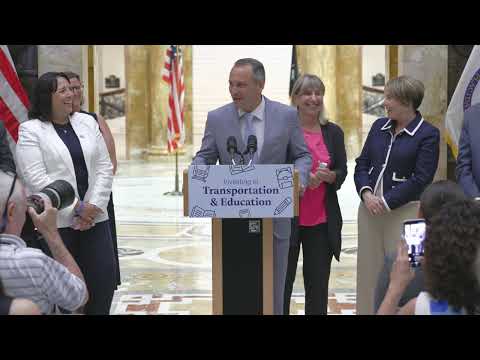
Gov. Maura Healey signs $1.38 billion ‘fair share’ supplemental budget for transportation and education
Summary
Gov. Maura Healey signed a $1.38 billion supplemental budget allocating funds from the state's "fair share" tax to the MBTA, regional transit, roads and multiple education programs including K-3 tutoring and special education support.
Gov. Maura Healey signed a $1.38 billion supplemental budget at the State House that allocates revenue from the state's "fair share" (millionaire's tax) to transportation and education programs across Massachusetts.
The supplemental budget directs roughly $535,000,000 to the MBTA and more than $500,000,000 in total toward transit stability, $100,000,000 for local roads and bridges, $50,000,000 to upgrade and connect regional transit authorities, $26,000,000 for high-dosage K-3 tutoring, $250,000,000 to help districts cover special-education costs and transportation, $100,000,000 to expand access to technical schools, and $45,000,000 to expand affordable childcare access.
Those allocations are intended to provide "real fiscal stability" for the MBTA and to accelerate improvements in service and reliability, Healey said. "For the first time in over 20 years, the T is running full speed, no slow zones on every line. Riders are saving a total of 2,400,000 minutes every single work day," she said, adding that the new funds will continue that work.
Senate President Karen Spilka described the investments as the result of the voter-approved funding source and legislative negotiation. "That is what this millionaire's tax fair share funding is for, and that is what we did," Spilka said, calling the bill and its allocations "game changers." Spilka also urged the public to view the State House, saying the building is "your house" when addressing a group of observing interns.
Business and civic leaders at the event urged sustaining long-term funding for transit. Jim Rooney, president of the Boston Chamber of Commerce, said transportation is the issue his members raise most often and noted that steady funding gives transit leaders the ability to plan. "This moment is about providing stability while we talk about how we're going to fund the big investments," Rooney said.
Officials at the signing credited MBTA leadership with operational improvements and framed the budget as the first major installment of a 10-year plan to address decades of underinvestment. The governor said the package will support improvements across the state, including paved and unpaved roads, microtransit, ferries and culverts, and that regional equity guided the allocations.
The supplemental budget was described at the event as the closing of the first year of implementing the fair share revenue. House and Senate leaders who spoke said they had worked to resolve differences and deliver the funds to the state. The governor and legislative leaders said federal support could not be relied on for these priorities and that Massachusetts must act with state dollars.
Officials did not outline detailed timelines for each project at the signing; they said agencies and transit managers will receive the funds and begin implementation. Questions about specific program rollouts, local award schedules and reporting timelines were not specified during the remarks.
Attendance and speakers at the event included Lieutenant Governor Kim Driscoll; Senate President Karen Spilka; MBTA General Manager Phillip Eng; Tom McGee, chair of the MBTA board; Jonathan Gulliver, Administrator; Jim Rooney, president of the Boston Chamber of Commerce; Doug Haugate, president of the Mass Taxpayers Foundation; and other legislative and administration officials who worked on the bill.