Get Full Government Meeting Transcripts, Videos, & Alerts Forever!
Get email alerts on the Infrastructure Resilience topic
No spam. Unsubscribe anytime.
Healy announces $3 billion 'Mass Ready Act' bond bill to fund resilience, water and housing projects
Summary
Governor Maura Healey announced the Mass Ready Act, a proposed $3,000,000,000 state bond bill to finance municipal and regional resilience projects, water and PFAS remediation, dam removals and culvert upgrades, and measures to speed housing and permitting.
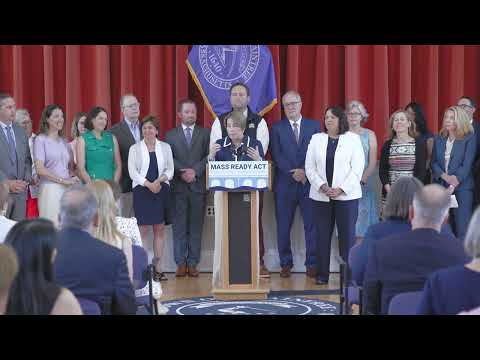
Governor Maura Healey announced the Mass Ready Act on Thursday in Braintree, a proposed $3,000,000,000 state bond bill intended to fund municipal and regional climate resilience, water and PFAS remediation, dam removals and culvert upgrades, food-security infrastructure, and expedited permitting to accelerate housing production.
The governor said the legislation “is a $3,000,000,000 investment in our state's infrastructure, in our communities, and in our economy,” and described measures intended to cut permitting timelines, provide low-interest resilience loans and finance coastal and inland projects meant to reduce future disaster costs.
The bill, as described by the administration, would authorize a set of targeted allocations and new financing tools. Secretary Rebecca Tepper described several of the administration’s stated priorities, saying the package includes $200,000,000 for coastal resilience, $20,000,000 for biodiversity priorities, and a $315,000,000 allocation to support municipal vulnerability preparedness (MVP) initiatives. Tepper also said the proposal would establish a new resilience revolving fund to offer low-interest loans to cities, towns, tribal governments and water districts for projects such as stormwater and road improvements.
“Every dollar that we invest and we spend now on strong infrastructure and natural restoration, we save us up to $13 down the road when extreme weather hits,” Secretary Tepper said, referencing the administration’s economic framing for the bill. Governor Healey also asserted that the administration expects each dollar invested through the bond to deliver multiple dollars in avoided future costs.
Administration officials and outside speakers cited the scale of deferred maintenance the bill aims to address. The administration said Massachusetts has about 3,000 dams—“over 200 of them are in poor condition”—and roughly 25,000 culverts and small bridges, many undersized for current rainfall patterns. The MVP program was highlighted as a delivery tool; the administration said MVP has helped 99% of Massachusetts communities assess local climate risk and plan projects, and the Mass Ready Act would provide $315,000,000 in funding to help communities move from planning to construction.
The bill also includes funding lines the administration described as targeting drinking-water and PFAS remediation; investments in parks, trails and boat ramps; support for food-security infrastructure described as delivering “4,500,000 meals a month to people in nearly every municipality;” and an emphasis on farm-support programs. Ben Clark, a fourth-generation grower, said state recovery funds and farm-viability grants have helped his operation recover from consecutive extreme-weather years and that the proposed investments matter to farmers and local food systems.
Business and labor leaders who spoke at the event framed the bill as both a resilience and jobs measure. Tamara Small of NAIOP Massachusetts praised the bill’s permitting reforms as a way to speed multifamily housing production, while Chrissy Lynch of the AFL-CIO and Adam Chapdelaine of the Massachusetts Municipal Association expressed support for the bill’s local-government and workforce implications. Conservation groups, represented by Steve Long of The Nature Conservancy, urged the measures to prioritize natural-system restoration, dam removals and salt marsh protection.
The administration said the Mass Ready Act would also streamline some environmental reviews and permitting processes to accelerate project delivery. Officials emphasized that the bill must still move through the Legislature; Healey said she looks forward to working with lawmakers and “getting this over the gold line and back to my desk for signature.”
No formal votes or enactments occurred at the event; the announcement was a policy rollout and filing of the proposed bond bill. Officials said they had conducted stakeholder engagement during bill development—Secretary Tepper said the administration had met with “over 300 stakeholder groups.”—and multiple cabinet- and agency-level officials were named as part of the initiative team.
What’s next: the administration said it will work with House and Senate leaders on the bill, which requires legislative approval and, if passed, would create the authorizations and funds described. The governor and administration representatives answered questions from the media after the announcement but did not announce any immediate, binding approvals or allocations at the event.