Get Full Government Meeting Transcripts, Videos, & Alerts Forever!
Get email alerts on the Electric Vehicle Charging topic
No spam. Unsubscribe anytime.
Board approves variance to remove curb for EV chargers at 4780 Roosevelt Boulevard
Summary
The Middletown Board of Zoning Appeals approved an area and dimensional variance allowing removal of curbing at 4780 Roosevelt Boulevard so Tesla can install electric vehicle chargers and create accessible pads; the board cited ADA access and site constraints in voting yes.
The Middletown Board of Zoning Appeals on June 4 approved an area-and-dimensional variance allowing the removal of curbing at 4780 Roosevelt Boulevard to install electric vehicle charging dispensers.
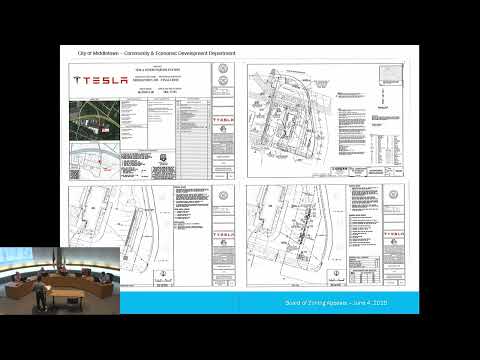
The variance request was presented by city planning staff and the applicant’s representative as necessary to make accessible charging dispensers flush with asphalt so a wheelchair user can reach the charger. City planning staff said the request relates to the Middletown Development Code, chapter 12-18-O-4, section g(5), which generally requires parking areas to be bounded by curbs. Miss Savage, a city planner, told the board the applicant argues the curb removal is needed so “the accessible charging dispenser [is] flush with the asphalt to create clear floor space,” which the applicant said is required by ADA reach standards.
Board members discussed alternatives, including placing curbing behind or around the prefabricated concrete pads and the potential need for a small retaining solution where the parking lot slopes into grass. The applicant’s representative, Andrew Vega of SSC, said the charger units would sit on prefabricated concrete foundations and that the pads would be contiguous; he also said the pads would in effect “sit[ ] its own curbing.” Board members asked about the length of the run of chargers and site grades; the applicant said the charger run measures about 76.5 feet and the pads extend roughly 8 feet from the parking edge into the grass.
Board members also asked whether bollards or other protections would be used; Vega said the units are secured on the prefabricated foundation and that bollards are used “on the ends” at some other installations. Members raised questions about whether the curb requirement could be met by installing curbing on the grass side of the pads; staff said revised plans would be required for additional engineering review if the applicant proposed that alternative.
There were no public speakers in favor or in opposition at the hearing. After discussion, a board member moved to approve the variance, citing the spirit and intent of the code and noting ADA access as a reason. The board voted 5–0 to approve the area-and-dimensional variance.
The approval is conditional only on the variance itself; staff said the city engineer had reviewed the submitted plans but that any revised plans would need to be submitted to planning and engineering for additional review. The applicant will need to comply with any required plan amendments and with applicable accessibility standards as the installation proceeds.