Get Full Government Meeting Transcripts, Videos, & Alerts Forever!
Get email alerts on the School Budget topic
No spam. Unsubscribe anytime.
Fairbanks North Star Borough School District confronts $1.75 million shortfall after governor veto; board debates using fund balance vs. cuts
Summary
At a June 23 work session the Fairbanks North Star Borough School District discussed a roughly $1.75 million FY26 shortfall after Gov. Mike Dunleavy's line-item veto reduced the district's anticipated state revenue by about $4.5 million.
Fairbanks North Star Borough School District officials told the board at a June 23 work session that a recent line-item veto by Gov. Mike Dunleavy reduced state revenue by about $4.5 million and created an estimated $1,750,000 shortfall in the district's FY26 budget.
Superintendent Luke Minor and Chief Operations Officer Andy DeGraw presented a revised budget picture and suggestions for closing the gap, saying the district now faces roughly $17.8 million in total reductions when prior deficit planning is included. "The governor's veto ended up being between 4.5 and $4,600,000," DeGraw said as he reviewed the numbers. He also explained how the veto affected charter allocations: "The $1,750,000 bottom line includes the $300,000."
Why it matters: the board already used one-time borough contributions and prior cuts to balance the proposed budget; the veto wiped out a June surplus and pushed the district toward additional reductions or a draw on reserves. Minor framed his recommendation as a limited use of fund balance and a small list of targeted reductions, saying, "Fund balance is there for unexpected expenses, and this certainly falls within that category." He recommended using under $1 million of fund balance if the board chose to support a legal effort addressing statewide school funding shortfalls.
What administrators proposed: DeGraw reviewed actions already taken in the district's FY26 plan and the incremental reductions being considered. Highlights included the prior closure of Midnight Sun Elementary, Pearl Creek Elementary and 2 Rivers Elementary (which the administration said produced about $4.6 million in savings), downsizing Salcha Elementary (roughly $500,000), contractor changes for evening custodial services (about $3 million in savings), assumed staff vacancy savings of just over $1 million, and district administration reductions of roughly $500,000. The presentation also listed districtwide personnel reductions that the administration said total just under 168 positions compared with FY25.
Options on the table: administration recommended a short list of further, limited reductions and said the board could instead use fund balance or increase the budgeted vacancy (negative contingency) to avoid cutting classroom staff immediately. Specific possible actions discussed included: eliminating a vacant secondary teaching position (DeGraw said it was "potentially at Lathrop"), closing or retaining the advertised Star of the North head-teacher posting and assigning an existing head teacher to cover both Star of the North and another program, and small contract or fee reductions. Board members repeatedly warned that more extensive cuts would be felt in classrooms and extracurricular activities.
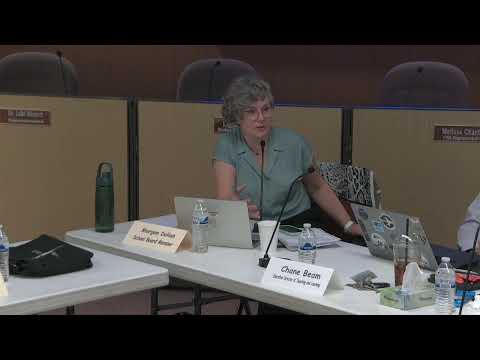
Board debate and positions: several board members said they opposed cutting additional elementary classroom teachers. Board member Missus Doolian said, "I'm very strongly in opposition to that," referring to a recommendation to eliminate five elementary and one secondary certified vacancies. Member Burgess favored using fund balance rather than making further classroom cuts and asked administration to prepare a prioritized cut list if the board needed to reopen the budget midyear. Member Doran said a $1 million fund-balance draw now would be a reasonable compromise to avoid immediate disruption and allow faster reversal if the veto is overridden in January. Member Missus Hardy urged the board to be explicit to the public about using reserves: "...we call it fund balance mostly because that better illustrates what we're doing."
Special education and vacancies: board members and staff discussed vacancies as an offset to the budget. Administration said the vacancy estimate cited in the proposed budget did not include special education positions. During the session Kate Hall reported roughly 33 (HR: 35) ESSA vacancies and about 10 FEA certified vacancies in special education, and administrators stressed that special education obligations limit where the district can cut without legal risk.
Other impacts discussed: administrators said the district would reduce some nonessential assessment costs (for example, dropping the science component of the MAP testing in the proposed reductions), and that activities and transportation carry limited options for immediate savings without larger service impacts. DeGraw noted that charter allocations were reduced by roughly $300,000 as a result of the BSA change tied to the veto and that foundation payments from the state are reconciled after the district's October 20 count and audited in mid-January.
Next steps: the board did not take final action at the work session; trustees will consider a resolution at the board's meeting scheduled for the next day. Multiple trustees asked administration to prepare a prioritized cut list and scenarios that could be enacted midyear if the veto is not overridden. Administrators said they would provide those materials and that many potential midyear cuts would be limited by contracts and legal obligations.
Closing: the board recessed and continued the discussion after a short break; the session closed with a reminder the next meeting would include the formal FY26 vote. The administration repeatedly emphasized that while fund balance can temporarily cover the shortfall, nearly every additional reduction would be felt by students, families and staff.