Get Full Government Meeting Transcripts, Videos, & Alerts Forever!
Get email alerts on the Tax Expenditures topic
No spam. Unsubscribe anytime.
House Committee on Revenue advances omnibus tax-expenditure bill HB 2087 to the floor
Summary
The committee adopted dash-2 amendments to House Bill 2,087, an omnibus tax-expenditure package that extends multiple tax credits and makes program-specific adjustments, and voted to send the amended bill to the House floor with a due-pass recommendation.
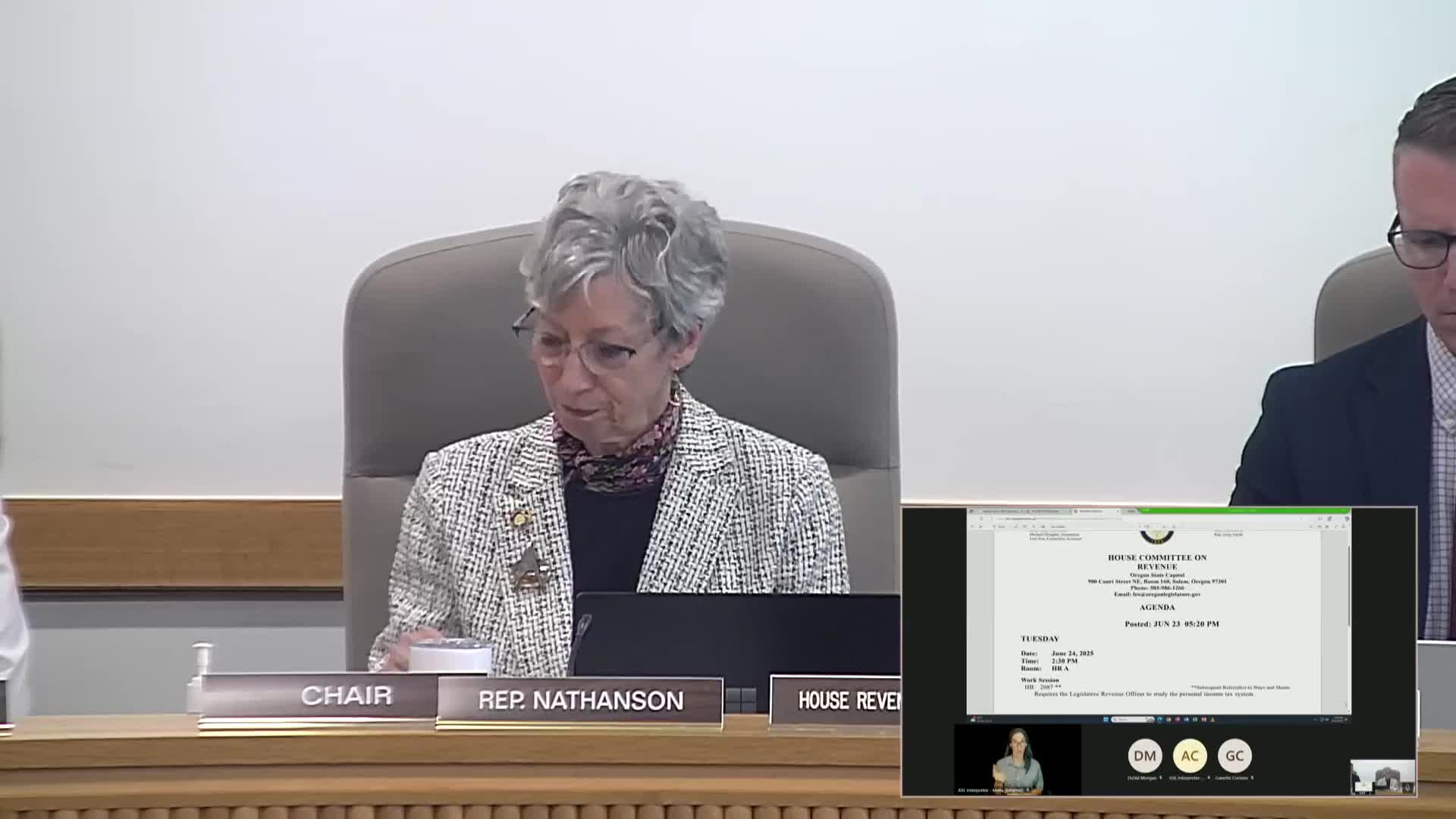
Madam Chair of the House Committee on Revenue on June 24, 2025, led the committee in adopting dash-2 amendments to House Bill 2,087 and voting to send the amended bill to the House floor with a due-pass recommendation and to rescind the subsequent referral to the Joint Committee on Ways and Means.
Kyle, a staff member who presented the measure, told the committee, “the dash 2 amendment is replacing the contents of the bill, and it's replacing it with, essentially this is becoming the omnibus, tax expenditure measure for this session.” The amendments bundle previously considered provisions and some changes vetted by the Joint Committee on Tax Expenditures.
The bill would extend several expiring tax expenditures for six years and adjust others. Key provisions in the dash-2 package described by Kyle include a six-year extension of the earned income tax credit; a six-year extension and increased value for the crop-donation tax credit; a six-year extension of the pension income tax credit for taxpayers age 62 and older; an extension for manufactured-dwelling-related credits and a manufactured-dwelling capital gain subtraction; an affordable-housing lender credit (with a minor language change that did not alter revenue impact); and incorporation of Senate Bill 101’s six-year extension for the first-time homebuyer savings account income tax subtraction.
The package also includes an increase to the rural volunteer EMS tax credit (originating in House Bill 3380), raising the per-taxpayer credit from $250 to $1,000 and applying a two-year sunset extension. Changes to IDA contribution and film-and-video tax credit annual caps were described as smaller than an earlier $6,500,000-per-year proposal because the updated caps reflect expected inflation over the next two years rather than the previous flat increase. Transportation-related provisions were added to address certain uses of Daimler trucks for emissions testing, avoiding the weight-mile tax for those vehicles when used for testing.
Several committee members spoke in support of specific pieces of the package. Representative Smith said she appreciated the crop-donation provision and said, “I'm really hoping in the interim to work with, our co chairs and with with representative Levy and others to see how we can support getting excess agricultural products to those who need them.” She also praised the increase to the rural volunteer EMS credit as important for frontier Oregon.
Representative Reschke voiced disappointment that the IDA contributions and film-and-video credits were reduced compared with earlier proposals, saying the co-chairs had been conservative because of budget uncertainty. Representative Marsh echoed the concern, noting that members generally support the programs and that tighter revenues mean the committee could not expand them as hoped.
On procedure, Vice Chair Walters moved to adopt the dash-2 amendments dated June 23, 2025; the motion passed without objection. Vice Chair Walters then moved that the committee send House Bill 2,087 as amended to the floor with a due-pass recommendation and rescind the subsequent referral to the Joint Committee on Ways and Means; that motion also passed without objection. The committee recorded the actions by voice vote; no roll-call tally was taken during the work session.
The committee's discussion emphasized maintaining currently operating programs in a constrained budget environment, and members repeatedly framed the package as preserving existing tax expenditures while leaving open the possibility of revisiting funding levels in a later session should revenue conditions improve. A committee member indicated they would “carry this one” to the next step. The chair said there might be an informational meeting in the future to update members on other work but gave no date.
The amended bill will proceed to the House floor for further consideration.