Get Full Government Meeting Transcripts, Videos, & Alerts Forever!
Get email alerts on the Mattress Epr topic
No spam. Unsubscribe anytime.
Commission hears Mattress Recycling Council presentation; members debate curbside, equity and statewide EPR design
Summary
The commission heard a presentation from the Mattress Recycling Council on existing EPR mattress programs and discussed whether Massachusetts should adopt a statewide EPR model. Commissioners and municipal officials highlighted curbside-collection equity concerns and asked staff for a draft recommendation similar to neighboring states.
Commissioners at the Extended Producer Responsibility Commission meeting on June 18 heard a presentation from Dan McGowan, northeast program manager for the Mattress Recycling Council (MRC), on mattress EPR programs operating in other states and discussed whether Massachusetts should adopt a similar stewardship model.
Dan McGowan described the MRC's nonprofit stewardship structure and its consumer-facing brand, BuyBuyMattress, which provides a statewide locator and education materials. "Our role is to administer the program that the law passes ... to make sure that it runs as smoothly, efficiently, and as transparently as possible," McGowan said, describing MRC's work procuring recyclers, transporters and collection sites and the point-of-sale fee that finances the programs in other states.
MassDEP staff summarized Massachusetts' experience under the mattress landfill-disposal ban (effective Nov. 2022). John Fisher said MassDEP has awarded about $2.7 million in municipal grants to 128 municipalities (with shared access for another 34), funded recycler grants of about $1.35 million, and equipment grants of roughly $400,000 to expand municipal collection. Fisher reported roughly 400,000 mattresses are captured for recycling in Massachusetts on an annual basis, based on reporting from known permitted processors.
MRC and DEP presenters outlined operations and costs. McGowan said recycling operations represent the large majority of program expenses (in Connecticut about 88% of fee revenues go to operations) and that many states achieve roughly a 75% recycling rate for processed material; MRC's model focuses on creating statewide, consistent access so consumers do not pay at disposal.
Municipal and advocacy participants emphasized local impacts and equity. Juanita Trabert (City of Newton) and other municipal officials said municipal programs vary widely and many cities now carry a material administrative burden to comply with the landfill ban; some cities provide free curbside pickup (Boston, Chelsea) while others charge residents $35'$75 or more. "Taxpayers are paying that or taxpayers are paying for the recycling of these mattresses," Juanita said, arguing that a point-of-sale fee would shift costs off general tax revenues to mattress purchasers.
Several speakers raised concerns about curbside service. McGowan and others noted curbside collection is expensive and raises program costs; MRC's model typically covers free drop-off at transfer stations and leaves optional curbside pickup as a local service paid separately because embedding curbside pickup into the statewide fee would raise the per-unit fee.
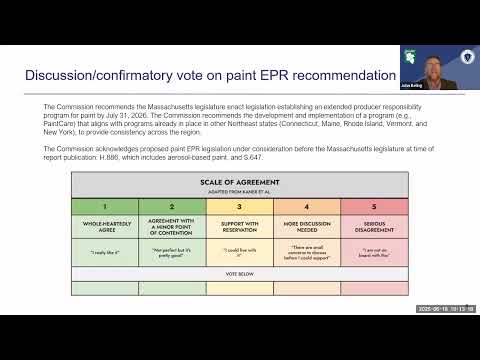
Commissioners asked staff to prepare a background memo and a draft recommendation for the Legislature that would mirror the approach taken for paint: recommend EPR legislation aligned with neighboring states and provide time for commission members and agencies to review the draft before a formal vote. No final vote to adopt a mattress EPR recommendation was taken at this meeting.
Key quantitative points discussed in the meeting: MassDEP grants totaling approximately $2.7 million to municipalities; grants to recyclers about $1.35 million; equipment/collection expansion grants about $400,000; MassDEP reported ~400,000 mattresses captured for recycling annually in Massachusetts; MRC cited more than 2,000,000 mattresses recycled in Connecticut and Rhode Island combined over ten years.