Get Full Government Meeting Transcripts, Videos, & Alerts Forever!
Get email alerts on the Appropriations topic
No spam. Unsubscribe anytime.
House Rules Committee: HB 2962–2974 ruled constitutional; attorney warns of appropriation-policy conflicts
Summary
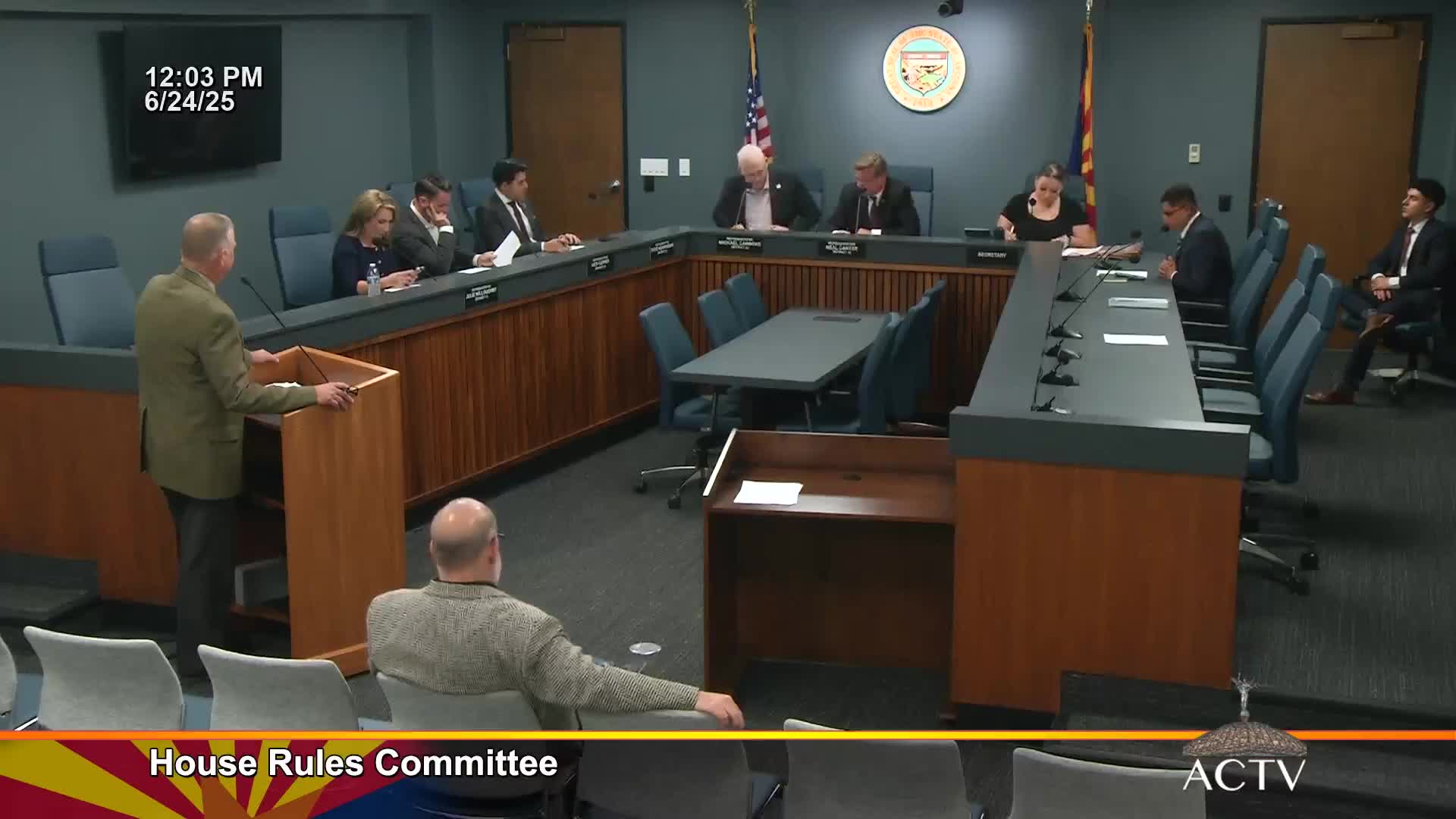
The Arizona House Committee on Rules voted 5-1 to find House bills 2962 through 2974 “constitutional and in proper form,” and the committee’s rules attorney warned some language in the FEED (General Appropriations) bill could cross from appropriation into policy and risk unenforceability.
The Arizona House Committee on Rules voted 5-1 to find House bills 2962 through 2974 “constitutional and in proper form,” and the committee’s rules attorney warned some language in the FEED (General Appropriations) bill could cross from appropriation into policy and risk unenforceability.
The vote was announced after a mass motion that the listed bills were constitutional. The motion passed by a roll call of 5 ayes and 1 nay. Representative Carbone, Representative Cooper, Speaker Montenegro, Representative Willoughby and Chairman Hendrix cast aye votes; Representative De Los Santos cast the lone no vote and asked to explain her vote.
The committee’s rules attorney, Tim Fleming, told members: “The FEED bill before you is House Bill 2,962, and as we often mention, the Arizona Constitution expressly talks about the General Appropriations Bill, which we call the FEED Bill.” Fleming said Article 4, Part 2, Section 20 of the Arizona Constitution limits the General Appropriations Act to appropriations for departments, institutions and public schools and requires other appropriations to be in single-subject bills.
Fleming pointed to specific provisions in HB 2962 that, he said, go beyond pure appropriation language. He flagged language in the Department of Child Safety appropriation (noted at page 16, lines 29–31) that implements training requirements for child-safety personnel, and language in the Department of Corrections appropriation (noted at page 23, lines 21–25) that implements restrictions on use of out-of-state provisional beds in prison facilities. He said these non-appropriation components “may be unenforceable” under precedents such as Sellers v. Froehmiller if left in the FEED bill.
“The risk is that where things in the FEED bill enact or potentially enact policy that goes beyond the appropriation itself, then cases like Sellers v. Froehmiller stand for the proposition that the non-appropriation portion of the law may be unenforceable,” Fleming said.
Fleming suggested the committee could avoid that risk by moving policy language into other bills, for example budget reconciliation measures, and also warned about so-called “strings” on appropriations that condition spending on post-enactment legislative reviews. He noted those conditions can raise separation-of-powers questions when the statute says an agency cannot spend until a legislative review (for example by the Joint Legislative Budget Committee) occurs.
Fleming also called attention to House Bill 2966 (described in the hearing as a health-care “burp”/budget reconciliation measure) and said language in sections 4–6 addresses county contributions and purports to exclude those contributions from county expenditure-limit calculations under the Arizona Constitution (mentioned as Article 9, Section 20). Fleming said his office is looking into whether that statutory approach is permissible in light of the Constitution.
Representative De Los Santos, explaining her Nay vote, criticized the broader Republican budget approach, calling it “This House Republican starvation budget” and saying it “will throw Arizona into chaos.” She said the budget cuts K–12 funding, ends free school meals, reduces services for veterans and denies pay raises for law enforcement and firefighters; she added, “It has 0% chance of ever being signed into law.”
Committee procedure: the motion that HB 2962–2974 are constitutional and in proper form was moved following the rules attorney’s remarks; the chair directed the secretary to call the roll, and the motion was recorded as passed by a corrected tally of 5 ayes, 1 nay, 0 present and 3 absent. The committee adjourned after the vote.
Discussion versus action: Fleming’s comments were advisory legal guidance to the committee (discussion). The formal committee action was the roll-call finding that the listed bills are constitutional and in proper form (decision). Representative De Los Santos’s remarks were an explanation of her recorded vote and not a committee directive.
What’s next: Fleming recommended members consider moving any non-appropriation policy language out of the FEED bill and into separate bills (for example, budget reconciliation bills) to avoid the enforceability and separation-of-powers risks he described. The committee took no further recorded action on those recommendations at this meeting.