Get Full Government Meeting Transcripts, Videos, & Alerts Forever!
Get email alerts on the Infrastructure Utility Relocation topic
No spam. Unsubscribe anytime.
Committee approves $21.29 million ALDOT reimbursable agreement to relocate utilities for Woolsey Fennell Bridge project
Summary
The Tuscaloosa City Projects Committee voted to authorize a reimbursable agreement with the Alabama Department of Transportation to relocate the city's water and sewer utilities to accommodate the Woolsey Fennell Bridge replacement, a project estimated at $21,292,635.01 that the state will reimburse in full.
The Tuscaloosa City Projects Committee voted to authorize a reimbursable agreement with the Alabama Department of Transportation to relocate the city's water and sewer utilities to accommodate the Woolsey Fennell Bridge replacement, a project estimated at $21,292,635.01 that the state will reimburse in full.
The agreement covers moving multiple large-diameter water mains and sewer crossings where utility lines currently run on the bridge and adjacent corridors. Committee members were shown maps identifying sewer relocations (green) and water relocations (blue). Timelines discussed at the meeting called for the city's utility work to be performed as a reimbursement-style agreement with the state and for the larger Allied utility relocation effort to take about two to three years once construction begins.
Why it matters: the relocation must be completed before or during the bridge replacement and involves major bores under the river and other corridors. Committee members and staff framed the agreement as a way to ensure the city is paid back for all relocation costs while minimizing road closures and direct traffic interruptions where possible.
City staff described key technical elements. The plan includes boring a water main under the river to remove the existing pipe from the bridge, and a separate bore under Campus Drive for a 24-inch main. "This will be a reimbursement-style agreement. So whenever we make a payment, we will file to the state for them to reimburse us," Mr. Gurney, a staff member, told the committee.
When asked about schedule, Brian, a staff member, said the city's project is expected to begin in early 2026 and last roughly 12 months, while the Allied utility relocation project is projected to span about two to three years once it is let. "We're looking at letting our project... start early next, you know, '26," Brian said.
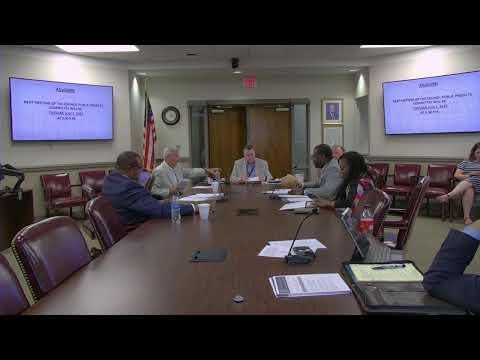
Committee discussion included questions about traffic disruption and construction sequencing; staff said most bores will occur outside travel lanes, limiting major traffic interruptions. The item passed with a motion and second and a unanimous voice vote.
Next steps: staff will execute the reimbursable agreement with ALDOT so relocation work can proceed on the schedule described and seek state reimbursement as invoices are billed.
Committee members suggested staff prepare public-facing information for districts likely to be affected, noting the scope and duration of the Allied contract could cause multi-year impacts in some corridors.