Get Full Government Meeting Transcripts, Videos, & Alerts Forever!
Get email alerts on the Open Meetings Training topic
No spam. Unsubscribe anytime.
Secretary of State staff: existing open-meeting video is available but expanded tracking, funding needed for wider training and accessibility
Summary
A Secretary of State working group discussed current statutory training, the limits of the office’s online video, gaps in tracking and funding, and next steps to create best-practice materials, multilingual resources and technical supports for public meetings.
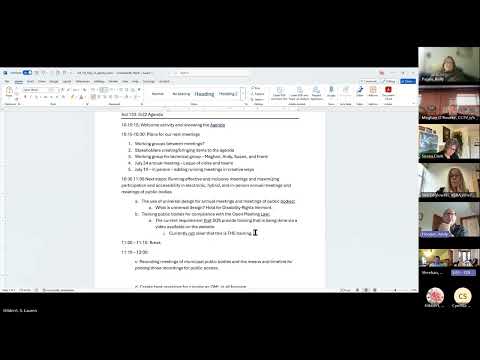
A staff member from the Secretary of State's office told a working group that the office already provides an online training video required by Act 133 but lacks the budget and software to track attendance or build a log-in system for mandatory trainings.
Why it matters: the group discussed how to make training and meeting practices accessible and verifiable for municipal officials and the public, including multilingual materials, templates for towns and technical requirements for hybrid meetings — tasks the office said will require additional funding and coordination with municipal associations.
During the session, a Secretary of State staff member said, "We have provided a video that anyone can watch at any time, and certain members of groups are required to do that by law." The staff member added the office does not currently have a method to log who has taken the training: "We will not have a login, because that requires software."
Participants pressed on whether training should be tracked more formally. The staff member said the legislature did not appropriate funds to build a login or tracking platform and that creating a certificate, log-in or the more technical "gold standard" solutions would require contracting and additional money. "We need some money so that we can hire a contractor to help us build that, and software to help us build that," the staff member said.
The group also discussed the scope and audience for training. A participant noted that school-trust and education law already require school board chairs and superintendents to complete eight hours of training annually, and another participant suggested developing materials for "aspiring municipal officials" and meeting moderators so newcomers know how local meetings operate.
Accessibility and language access were recurring themes. Members urged materials be available in multiple languages and formats; one participant pointed to the Vermont Language Justice Project and said translated videos, including ASL, helped clarify core information for new Americans and others with limited English proficiency.
The working group agreed on several next steps and directions rather than formal votes: Secretary of State staff and two named office members will draft a best-practices document for public meetings, explore partnerships with the League of Cities and Towns and other groups, and collect existing resources and templates towns can adapt. The group scheduled an in-person meeting for July 10 to work on accessibility and a technology-focused meeting for June 6.
No formal motions or votes were recorded during the discussion. Several participants emphasized that any plan to require tracked or proctored online training would need legislative funding and technical resources before it could be implemented.
The working group noted existing models and resources — municipal training by the League of Cities and Towns, local clerk/treasurer associations, and examples like translated voter videos — that the Secretary of State's office could gather and link from a central web page so towns and the public could easily find recommended training and templates.
The office and participants flagged next steps that include: drafting a concise best-practices document for public bodies; exploring grant or legislative funding for tracking and professionalized online content; coordinating with municipal associations for outreach; and creating multilingual, plain-language materials and a town "operator's manual" template that towns can adapt.
The Secretary of State's working group did not adopt any new rules or enforcement mechanisms at the meeting; staff described the current approach as primarily "the carrot, not the stick" in terms of encouragement and voluntary compliance.