Get Full Government Meeting Transcripts, Videos, & Alerts Forever!
Get email alerts on the Massage Establishment Ordinance topic
No spam. Unsubscribe anytime.
Bloomington council approves amended massage-establishment ordinance after weeks of public comment
Summary
The Bloomington City Council voted June 23 to adopt an amended massage‑establishment ordinance that sets a one‑time $100 application fee (including a $75 background check), eliminates annual fees, exempts some sole proprietors with conditions, and removes a dress‑code requirement.
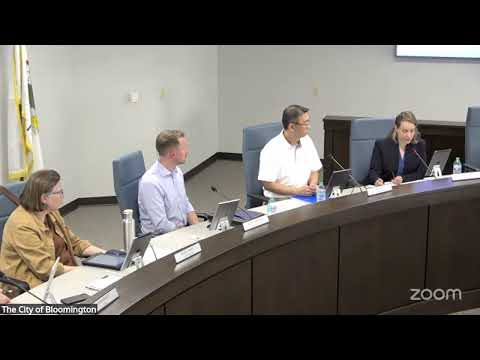
The Bloomington City Council voted June 23 to adopt an ordinance amending Chapter 22 of the Bloomington City Code to add regulations for massage establishments after several weeks of public comment and staff revisions.
Council Member Ward moved to adopt the ordinance with three text amendments: (1) revise application requirements to remove outdated personal data while retaining background‑check support (Text Amendment 1); (2) exempt sole proprietors from the full establishment application while requiring a copy of the state license and a sworn affidavit that they are a single‑operator business with limited operating requirements (Text Amendment 3); and (3) remove the ordinance’s dress‑code provisions (Text Amendment 4). The motion was seconded and carried with no nays.
City Manager Jeff Jurgens explained the final fee structure and background‑check approach before the vote. “The application fee stays as a $100, but that includes the $75 that we’ll have to pay for the background check,” Jurgens said, and staff proposed setting the annual licensing fee to $0 in the fee schedule. He told council that some questions in the draft ordinance (for example, height and eye color) were carried forward from older code and recommended removing them. Legal counsel described Social Security numbers and other identifiers as data used for background checks and limited to individuals who “currently hold management and or supervisory authority over business operations.”
The ordinance’s central features as approved: - $100 one‑time application fee; that amount includes the estimated $75 background‑check cost paid by the city. - No annual licensing fee (fee schedule shows $0 for renewal). - Text Amendment 1 removes archaic personal characteristic questions (for example, height, weight, eye color). It keeps Social Security numbers and other identifiers where necessary for conducting background checks for management/supervisory individuals or owners. - Text Amendment 3 creates a limited exemption for sole proprietors who operate as single‑person commercial establishments; those sole proprietors must submit a copy of their Illinois state massage license and a sworn statement that they operate alone. The amendment provides a narrower set of operating requirements for sole proprietors than for larger establishments. - Text Amendment 4 deletes the ordinance’s dress‑code requirements (for example, language requiring nontransparent outer garments and prohibiting disrobing in the presence of clients).
The issue drew extensive public comment from licensed massage therapists who said parts of the proposed ordinance were overly intrusive and would burden solo practitioners. Amanda Boitnott told council she and other therapists are “credentialed, trained, and committed to ethical client‑centered care” and urged the city to “slow down and work together to craft policy that’s informed, fair, and acknowledges the integrity and regulation already in place.” Several speakers asked why the city would request sensitive personal information — for example, Social Security numbers, birth date and physical descriptors — and said many of those items were irrelevant to a business licensing review.
Council members debated balancing the goal of identifying illicit operations used for trafficking with avoiding unnecessary burdens on legitimate therapists. Council Member Montney expressed concern that relaxing requirements for sole proprietors could create loopholes, while Council Member Ward said several specific items (height, eye color, dress code) were not appropriate for the city to require. City legal counsel explained that Social Security numbers are used as part of background checks and that floor plans can assist public safety responses.
Before the vote, Council Member Scott urged continued coordination with local service providers such as the Center for Prevention of Abuse to ensure that if victims are identified, they receive services and support. After the roll call, the clerk announced no nays to the motion; the ordinance was approved with the three text amendments.
The council did not provide an ordinance number in the meeting record and did not set an implementation deadline in the hearing. Staff said it will proceed with administrative steps to implement the licensing program consistent with the council’s amendments.