Get Full Government Meeting Transcripts, Videos, & Alerts Forever!
Get email alerts on the State Legislature 2025 topic
No spam. Unsubscribe anytime.
Covington lobbyists summarize 2025 Washington session: Jenkins Creek money, SR 18 funding and a 6¢ gas tax increase
Summary
Emily Shea and Brianna Murray, the city-contracted lobbyists who represented Covington in Olympia this year, told the City Council on June 10 that the 2025 legislative session produced several outcomes the city should expect to affect transportation, parks and public safety funding.
Emily Shea and Brianna Murray, the city-contracted lobbyists who represented Covington in Olympia this year, told the City Council on June 10 that the 2025 legislative session produced several outcomes the city should expect to affect transportation, parks and public safety funding.
The most immediate wins for Covington included a $500,000 capital-budget allocation for the Jenkins Creek Trail and preservation of existing funding for the city’s State Route 516 project. Council members were also told the final transportation budget allocates $15 million to the State Route 18 widening and safety project in the upcoming biennium and $25 million in the next biennium, while the project’s schedule will shift so advertisement occurs in 2029 rather than 2027.
Why this matters: the allocations change the timing and cash flow for two projects long discussed by Covington officials — Jenkins Creek Trail and SR 18 — and the transportation revenue package also changes how local governments receive new gas-tax revenue.
Shea and Murray framed the session as a long, contentious budget year. Shea said the 2025 session lasted 105 days and produced new operating, capital and transportation budgets after leadership addressed a large operating shortfall. According to the presentation materials and the lobbyists’ remarks, the state’s 2025–27 operating budget left roughly $2.3 billion in reserves, relied on about $4.5 billion of new taxes and fees, and the capital budget relied primarily on bond sales to fund local grants and projects.
On Covington priorities, the brief included these items:
- Jenkins Creek Trail: Covington requested $867,000 in the capital budget; the final budget provided $500,000 toward the project. Shea credited Representative Stearns of the 47th Legislative District for helping secure the award and noted the city also received a $1,950,000 Washington Wildlife and Recreation Program grant that will contribute to the project.
- SR 18 widening and safety project: The lobbyists said the final transportation budget included $15 million in the upcoming biennium and $25 million in the subsequent biennium; design and mitigation work will continue and WSDOT will advertise the project in 2029 rather than 2027. Murray told council members the house and senate had markedly different proposals during negotiations and the final conference outcome spread funding over multiple biennia.
- Transportation revenue changes: The legislature approved a 6¢ increase in the gas tax and indexed it to inflation; the new package sets aside 2.5% of the additional funds for local revenue sharing to cities. Murray noted the legislature considered, but did not advance, a broader road-usage charge as an immediate alternative because public feedback was strongly opposed.
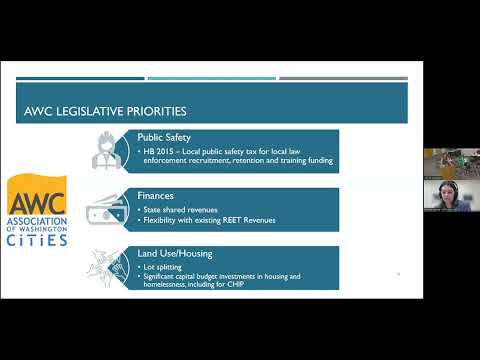
- Public safety grants and local sales-tax authority: The legislature adopted a version of the public safety bill that funds $100 million in hiring grants and authorizes counties and cities to impose a 0.1% (one-tenth) sales-tax increase for public safety. On the bill’s conditions, Murray said local agencies must comply with recent law-enforcement reform policies enacted since 2019 and that there is “some ambiguity” about how certain new requirements will be implemented; she added the Association of Washington Cities is coordinating with the Criminal Justice Training Commission to clarify timelines.
Other items noted by the lobbyists included changes to local finance rules and housing policy developments. Shea summarized that the legislature passed house bill 1791 (as presented to council) to expand allowable uses of certain refunds for operations, maintenance and affordable housing projects, and the session included multiple housing bills touching lot splits, accessory dwelling units and compliance review processes under the Growth Management Act.
Council questions focused on the public-safety sales-tax authority and how local agencies will meet the bill’s training and operational conditions; Murray said King County’s Sheriff’s Office is already addressing some requirements and that state agencies and associations are working to define implementation details. On transportation finance, council members pressed whether the decline in gas-tax collections is due to increasing vehicle efficiency and electric vehicles; the lobbyists confirmed the legislature continues to study road-usage charges but opted for a gas-tax increase in 2025 because public opposition remains strong.
A written, session‑end report the lobbyists provided to council contains line‑by‑line budget summaries and a bill list; Shea said the full report is included in the council packet and that the lobbyists will continue interim work and monthly updates to the city.