Laramie Regional Airport outlines capital projects, compliance gains and long-term funding needs
Loading...
Summary
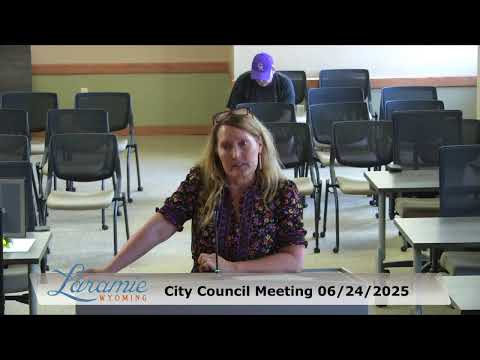
Airport Director Amy Terrell told the Laramie City Council the airport has returned to compliance, completed several capital upgrades and is saving federal grant match funds for a planned $9 million apron replacement, but warned the airport needs new local revenue sources to remain sustainable.
Airport Director Amy Terrell told the Laramie City Council on June 24 that federal grants and local match funds are funding a string of safety- and infrastructure-focused projects at the Laramie Regional Airport, while operating revenue has recovered after a deep dip in 2022.
Terrell said the city’s annual $205,000 fee-for-service contribution represents about 6.8% of the airport’s operating budget and described completed and upcoming projects funded with AIP (Airport Improvement Program) and Infrastructure Investment and Jobs Act (IIJA/IDJA) dollars and local matches. “The $205,000 that you, are putting towards the airport annually or last year and this year accounts for about 6.8% of our entire operating budget,” Terrell said.
The airport received a new Aircraft Rescue and Fire Fighting (ARFF) truck with federal AIP support (federal share about $971,369), replaced runway and taxiway lighting, acquired a rotary plow for winter operations and is planning a major apron reconstruction estimated at $9,000,000. Terrell said the airport has set aside local match money, partly from CARES/CRRSA/ARPA-era funds, to meet project requirements and timelines.
Why it matters: Terrell told council that, while capital projects are under way and grant compliance has been restored, operating revenue must grow for the airport to remain sustainable without increasing annual city or county subsidies. She recommended pursuing development of airport-served land and other local revenue sources to reduce long-term dependence on general fund support.
Most important developments and financial context
- Project pipeline: completed ARFF truck acquisition, runway and taxi light replacement, and a planned expansion of the ARFF building to house new equipment. Upcoming projects include taxiway rehabilitation, pavement crack sealing, and the $9 million apron reconstruction slated for federal/state approval and local match funding. - Grants and funding: Terrell said the airport uses four primary funding streams — IIJA/IDJA funds, AIP funds, local government operating support, and operating income — and that federal funds are project‑restricted while local match must be available for construction phases. - Operating and revenue trends: Terrell summarized multi‑year revenue swings: roughly $1.5 million in 2019, $1.3 million in 2020, $1.1 million in 2021, a drop to about $337,000 in 2022, recovery to approximately $2.29 million in 2023, and about $2.9 million year‑to‑date in the current year. The adopted operating budget was roughly $3.01 million with projected expenditures of about $3.26 million, yielding a near‑term shortfall Terrell identified as chiefly in fueling revenue.
Compliance and operations
Terrell reported that the airport and its grants are now in full compliance after earlier oversight work with the FAA, Department of Homeland Security and other agencies. She said a prior Part 13 complaint to the FAA produced no adverse findings. The airport has also upgraded training (including sending staff to snow‑removal training) and corrected items such as missing fuel‑farm placards following FAA inspection findings.
Sustainability concerns and proposed directions
Terrell repeatedly emphasized long‑term sustainability concerns for non‑hub commercial airports, noting limits on operating revenue and rising compliance costs. She described several possible revenue pathways the airport is pursuing: developing a business park on roughly 65 plumbed acres adjacent to the airport, pursuing ballot measures such as a local option (6p) tax, seeking hangar development that could generate significant revenue (Terrell estimated a new hangar could generate up to about $500,000 annually), and continuing efforts to grow charters and fuel sales.
Council response and follow-up
Council members asked about enplanements, SkyWest and TSA lease revenue increases, cost centers and the airport’s charter and university business. Terrell said the airport exceeds the 10,000 annual enplanements threshold used for some federal funding and that lease renegotiations (SkyWest’s lease was increased from about $15,984 to $82,582 annually) and a new facility user fee line are boosting operating revenues.
No formal council action was taken. Terrell said she will work with city staff, the county and the Wyoming Business Council to develop a land‑use plan and to return with business‑park proposals and additional budget options.
Ending
Terrell said she plans to provide regular updates to the council on essential air service, charters and capital projects. “This is really your airport,” she told council, inviting members to tour airport facilities and the airfield. The airport director asked the council and public to consider longer‑term revenue options so the facility can remain competitive and compliant without growing annual general fund requests.