Get Full Government Meeting Transcripts, Videos, & Alerts Forever!
Get email alerts on the No Right Turn On Red topic
No spam. Unsubscribe anytime.
Salem committee reviews sweeping ‘no right on red’ ordinance updates after pedestrian-safety debate
Summary
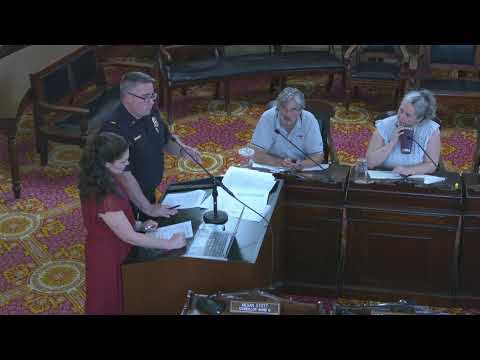
The Salem City Council Committee on Ordinances, Licensing and Legal Affairs met June 23 to review Transportation Commission recommendations to add, clarify or remove "no right on red" restrictions at roughly 30 intersections across the city.
SALem City — The Salem City Council Committee on Ordinances, Licensing and Legal Affairs met June 23 to review final Transportation Commission recommendations to add, clarify or remove "no right on red" restrictions at roughly 30 intersections across the city.
Christina Hodge, Assistant Transportation Director, presented the package and said staff and commissioners evaluated sites based on “crash history, pedestrian volumes and intersection geometry and sight lines.” The recommendations included a mix of: (a) adding signage where no ordinance exists, (b) adding ordinance language where signs already exist, and (c) cleaning up archaic or duplicate ordinance text.
Why it matters: The changes would make some restrictions enforceable, alter where drivers may legally turn on red downtown and in neighborhood corridors, and affect pedestrian and bicycle safety in high-foot-traffic areas such as the visitor center, Pickering Wharf and the Derby Street/Harbor area.
Committee debate focused on the trade-off between pedestrian safety and traffic flow. Ward and downtown councilors raised three recurring concerns: (1) whether added prohibitions would simply push motor traffic onto nearby private property such as Pickering Wharf and create a new hazard; (2) whether signal timing and detector issues must be fixed before changing permitted turns; and (3) whether some locations would be better served by temporary or illuminated signage tied to the pedestrian phase rather than blanket ordinance bans.
On votes and motions, the committee acted on several discrete items in the package. Two formal changes were approved by recorded motions: the committee voted to add a prohibition on eastbound Norman Street turning right onto southbound Washington Street (no right on red) (motion by Councilor Cohen, seconded by Councilor Morsello; tally recorded as 3–1 in favor). The committee also voted to remove the proposed prohibition for westbound Washington Street turning right onto northbound Washington Street (motion by Councilor Cohen, seconded by Councilor Jerslow; tally recorded as 3–1 in favor). A separate motion to remove language prohibiting northbound Congress Street onto eastbound Derby Street was made but received no second and did not proceed.
Several intersections drew extended discussion: Pickering Wharf/Derby Plaza (where commissioners and councilors worried that prohibiting right turns would divert drivers through the private wharf and across pedestrians), the Congress–Derby–Wharf area (where commissioners split over preserving throughput versus protecting heavy tourist-area pedestrian crossings), and North Street/Federal Street (where several councilors noted persistent signal-timing and detection problems that cause driver frustration and violations regardless of posted restrictions). Commissioners also flagged corridor-level projects — notably Jefferson Avenue — as relevant background but not immediately altered by this ordinance package.
Staff and police noted enforcement and technology constraints. Lieutenant Tucker of Salem Police and transportation staff said that illuminated signs that temporarily prohibit turns during an activated pedestrian phase exist but are costly; staff recommended prioritizing where such technology might matter most. Staff also advised that some changes are primarily “cleanup” — consolidating poorly worded, duplicate or decades-old text into clearer ordinance language and aligning posted signs with enforceable code.
The committee did not approve the full package for final adoption. At the end of the meeting the committee voted to keep the ordinance package in committee for further work (motion by Councilor Morsello, seconded by Councilor Jerslow). Committee members asked staff to: (a) clarify paired repeals/insertions in the draft language; (b) identify where signs already exist but lack ordinance backing; (c) bring additional signal‑timing and detection information for key intersections; and (d) return with any low-cost illumination or pedestrian-trigger signage options for high-priority locations.
The full recommended package and detailed intersection list will return to committee for further refinement and additional votes. Staff said the Transportation Commission materials and intersection maps would be updated to reflect the committee’s instructions before the next meeting.